

Axe Throwing Waiver: Safety Rules, Equipment Risks, and Participant Conduct
Axe throwing waiver agreements safeguard both you and the venue during your participation in this exciting activity. The vital paperwork acknowledges what it all means before you can start throwing axes at wooden targets.
The waiver for axe throwing plays a significant role at axe throwing facilities. Your waiver form needs personal information and emergency contacts, and remains valid until the year ends. Parents or guardians must complete the paperwork for any minors joining the activity.
This piece covers everything about axe throwing waivers – from safety rules to equipment risks and conduct guidelines. You’ll discover the document’s contents, proper completion steps, and reasons behind the paperwork that lets you enjoy axe throwing with friends, family, or colleagues.
What is an Axe Throwing Waiver?
An axe throwing waiver is a legal contract between you and the venue that runs the activity. This document means you give up your right to seek compensation if you get hurt while participating. You can think of it as your formal acceptance of risk before you start throwing sharp objects at wooden targets.

Why waivers are required
We needed these waivers because axe throwing comes with obvious dangers. Even with safety measures in place, accidents can happen when people handle sharp tools. The venue asks you to sign a liability waiver before handing you an axe to protect against lawsuits and unexpected costs.
Insurance companies just need these waivers before they’ll cover axe throwing businesses. Many venues can’t get the insurance they need to operate without proper documentation.
A waiver is a vital part of informed consent. It lets you know about possible dangers before you decide to participate. People sign online waivers so often these days that they might think an activity is risk-free if nobody asks them to sign anything.
Legal protection for businesses
A signed liability form won’t stop someone from suing an axe throwing venue, but it substantially improves the business’s odds of winning legal challenges. The document proves you knew about the risks involved.
The waiver won’t give absolute protection. A business that acts negligently can’t hide behind the waiver. If they knowingly use faulty equipment or don’t give proper safety instructions, they’re still responsible for whatever you signed.

You take on more responsibility as the customer when you sign. This makes winning a lawsuit harder if you get hurt during normal participation. The venues can offer exciting but dangerous activities while managing their legal risks.
What participants agree to
When you sign an axe throwing waiver, you accept:
- Everything that could go wrong with axe throwing, including damage to property, injury, or death
- You won’t sue the venue, its owners, staff, and other protected parties
- All risks tied to the activity, whether you know about them or not
- You’ll follow all safety instructions and rules from staff
- Staff can give emergency first aid if needed
- You’ll return equipment in good shape
- You’re healthy enough to participate
- The venue might use your photo or video to promote their business
The document clearly states that your signature means giving up certain legal rights, including the right to sue.
Kids need their parents or legal guardians to sign because they can’t enter binding contracts. Each venue sets its own minimum age, usually between 6 and 12 years old, and kids need proper adult supervision.
Axe throwing waivers create clear guidelines between businesses and customers. This paperwork helps everyone understand their role in balancing fun with safety in this popular recreational activity.
Key Elements of a Waiver for Axe Throwing
Axe throwing waiver forms have several vital components that protect both participants and venue owners. You should understand these elements to complete the paperwork correctly and learn what you’re agreeing to.
Personal information and emergency contacts
The original section of any axe throwing waiver needs your simple personal details. You’ll need to provide:
- First and last name
- Email address
- Phone number
- Date of birth (to verify age requirements)
On top of that, axe throwing venues need emergency contact information. They’ll ask for the name and phone number of someone they can reach if an accident happens. Some places might want your address too.
This information serves two purposes. The venue can identify who completed a waiver and has vital contact details if medical attention is needed.
Acknowledgment of risks
The heart of an axe throwing waiver lies in acknowledging potential dangers. Your signature confirms you understand that:
- Axe throwing has risks that could lead to serious physical injury
- You might face scarring, loss of bodily function, permanent disability, or even death
- Risks can come from your actions, other people’s actions, or equipment conditions
- The venue can’t list every possible risk of the activity
Most waivers use specific language stating you “voluntarily assume all inherent risks, both known and unknown”. You’ll often need to initial each risk statement to show you’ve read and understood everything.

These statements might sound scary, but they reflect real possibilities, even if they rarely happen. Venues must be clear about all potential outcomes, even the unlikely ones.
Parental consent for minors
Kids under 18 can’t legally sign binding contracts. A parent or legal guardian must complete the waiver for them. This part usually has:
- A statement showing the signer’s legal authority as parent/guardian
- Agreement to take responsibility for the minor’s actions
- Agreement to protect the venue against claims about the minor’s participation
- Room for the minor’s name and date of birth
More than that, many venues want the parent or guardian to stay on-site during the activity. Some places make it easier for families by letting one parent fill out a single form for multiple children.
Signature and expiration
The last part of an axe throwing waiver is where you sign. Modern venues give you two ways to sign:
- Digital e-signatures on tablets, computers, or phones
- Traditional pen-and-paper signatures
All waivers include the current date, which digital systems add automatically.
People often miss the waiver’s expiration date. These forms usually expire at the end of each calendar year, unlike many legal documents that last forever. Regular visitors need to fill out a new form every year. Youth waivers stop working when the minor turns 18.
These time limits let venues update their terms and make sure participants know about any policy changes or new risks since their last visit.
Understanding the Safety Rules
Safety rules are the foundations of every axe throwing waiver form. These guidelines protect you from injuries and help venues create a secure environment for everyone.
Closed-toe shoes and proper attire
Reputable axe throwing facilities have one rule that’s set in stone – you must wear closed-toe footwear. This rule applies to everyone. Your shoes protect you from axes that might fall or bounce back and shield your feet from splinters that fly off wooden targets.
Athletic shoes with non-slip rubber soles work best because they keep you stable as you move during throws. Most venues won’t let you throw in high heels, even if they cover your toes. These shoes make your stance unstable and create risks.
Your clothing choices matter a lot for safety and performance. The best outfit has:
- Fitted athletic wear or comfortable jeans
- Close-fitting shirts that let you move freely
- Cotton-blend fabrics that breathe yet stay in place
Loose or flowing clothes can be dangerous. Big hoodies, scarves, and dangling jewelry might catch your arm during backswing. This disrupts your throw and could cause accidents. You might need to remove these items before you start.
Throwing techniques and lane etiquette
Safe axe throwing starts with knowing the simple safety rules for lane behavior. The most important rule: stay behind the fault line until axes stop moving. Standard hatchet throwing needs 12 feet between you and the target.
Lane judges or “Axeperts” show you the right form and safety steps. Listen to their instructions – no exceptions. You must stay behind the throwing line until judges call all scores.
The timing of your throws matters too. Wait for people in nearby lanes to finish their throws. This prevents accidents and keeps everyone safe.
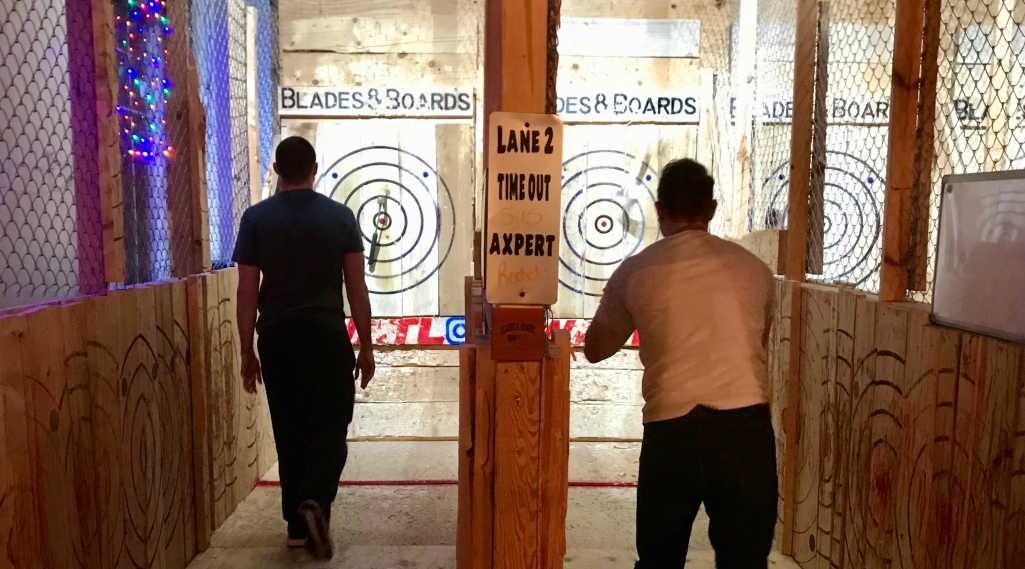
Point the blade away from you during overhead throws. Stay aware of your surroundings and make sure all throwers are in the safety zone.
Here’s a rule people often forget: don’t walk around with an axe. Put it back in storage or give it to staff.
No alcohol or drugs before participation
Many venues serve alcohol, but they have strict rules about drinking. Show up clear-headed and sober. Staff members look for signs that someone isn’t fit to throw and can stop them from participating.
Venues that serve alcohol use these safety measures:
- Age checks (21+ only)
- Wristbands for drinkers
- Strict limits (usually 3 drinks max while throwing)
- No drinks while throwing
- Staff gets the final word on who can throw
Everyone must follow the “no shenanigans” rule – coaches can stop you from throwing if you act irresponsibly. You might have to leave without getting your money back.
Drinking isn’t the only issue. You need to follow all venue rules about alcohol. Most places want you to tell your instructor if you plan to drink.
Your signature on the waiver means you’ll follow these safety rules. Breaking them can get you kicked out of the throwing area. These guidelines help create a safe environment and protect you from getting hurt during this exciting activity.
Common Equipment Risks in Axe Throwing
Axe throwing venues need to deal with equipment-specific hazards beyond standard safety rules. These hazards shape the detailed liability language in your waiver form. The risks range from blade conditions to target integrity.
Blade sharpness and handling
The sport requires a careful balance in axe blade sharpness. Good venues make sure their axes are “sharp enough to stick to the targets but not sharp enough to harm yourself to the touch”. This approach helps prevent handling injuries and throwing frustrations.
Handling axes is riskier than throwing them. Industry data reveals that “most injuries aren’t from axes being thrown but rather from improper handling before or after throwing”. Many facilities have “designated bins for axes to be placed in between turns” instead of letting participants hand axes directly to each other.
These simple handling precautions are essential:
- Never pick up axes by the blade
- Avoid passing axes directly between participants
- Keep axes away from open areas where they might be mishandled
Regular equipment checks are vital. “Axes inspected regularly for cracks and replaced as necessary” help prevent unexpected blade failures or handle separations during throws.
Bounce-back risks
Bounce-back occurs “when an axe doesn’t stick to the target and rebounds towards the thrower or others nearby”. Well-designed venues rarely see this happen, but it remains one of the most serious equipment risks.
Bounce-backs can happen due to several factors:
- Wrong release or throwing angle
- Targets that are too hard or dry
- Axes that are either too sharp or too dull
- Wrong axe rotation (over-rotation or under-rotation)
Power can make things riskier. “Overthrowing can cause the axe to bounce off the target instead of sticking”. Too much force prevents the blade from penetrating properly.
Sometimes unusual accidents happen. One case involved “a throw that was close to the target, bounced off the floor, and ricocheted off the footer, and back at the thrower”. Safety experts later found that “the combination of mats on the floors when paired with the type of axe used with a rubber handle” made this possible.
Improper throwing form
Bad throwing technique makes injuries more likely because axes behave unpredictably. People often use too much force, rotate incorrectly, or release at the wrong time.
“Participants who have not received proper instruction may throw axes dangerously or unpredictably”. Quality venues give thorough training and supervision for this reason. An axe that rotates incorrectly might hit the target handle-first or side-first, which makes bounce-backs more likely.
New throwers often try to throw harder instead of smarter. Experts point out that “a smooth, controlled throw is always more effective than brute force”. You’ll find this principle mentioned throughout axe throwing waiver forms as a vital safety concept.
Faulty or damaged targets
The target condition affects both safety and performance. Experts say that “hardwoods like oak or maple make terrible targets because they don’t absorb the axe blade properly, leading to frequent bounce backs”. Softwoods like pine, poplar, or spruce let axes sink in safely.
Target maintenance needs careful attention. “Prior to each event, axe throwing coaches go through and complete a checklist of items, including checking and changing the target boards”. This helps prevent dangerous issues like:
- Dried-out boards that become hard over time
- Damaged target sections with splinters or cracks
- Poorly mounted boards that might move during impacts

Good venues replace target sections regularly. A waiver for axe throwing typically asks you to acknowledge that equipment might fail, though this rarely happens.
Target border design also matters for safety. Some facilities no longer use certain materials after they learned these could create unusual bounce patterns. This ongoing evaluation shows how committed the industry is to keeping participants safe.
Participant Conduct Guidelines
Safety and enjoyment in axe throwing depend on how participants behave. The waiver you sign has more than simple safety rules. These guidelines protect everyone who takes part in this high-energy activity.
Respect for staff and other players
Good sportsmanship starts with how you treat venue staff and fellow throwers. Axe throwing codes tell participants to “treat all players and officials with respect”. This means valuing your coach’s expertise and acknowledging other players’ skills.
Waivers at most venues ban discrimination. Professional guidelines state that discrimination based on “race, ethnicity, gender identity, sexual orientation, age, physical or mental ability, or religious beliefs” won’t be allowed. These rules help create a welcoming space for everyone.

Courtesy matters in practical ways too. Stay behind the throwing line when others throw. Give people their space. Keep a safe distance from nearby lanes. Your actions shape everyone’s experience.
Good sports stay calm after a bad throw or when others succeed. Professional leagues want players to “demonstrate good sportsmanship before, during, and after games, win or lose”. This applies whether you compete or throw for fun.
Following instructions at all times
Staff instructions keep you safe – they’re not optional. Your signature on the waiver shows you’ll “pay close attention to their safety briefing and always follow their instructions”. Listen to advice about throwing technique, lane rules, and what to do in emergencies.
Certified instructors know about possible dangers. Safety guidelines tell us that “participants who have not received proper instruction may throw axes dangerously or unpredictably”. Ignoring staff directions puts people at risk.
Rules apply everywhere on the property – from “equipment, common areas, playing areas, parking areas, and surrounding neighborhoods”. How you act reflects on you and the venue.
Here’s the golden rule at axe throwing facilities: “axes shall never be thrown when anyone is past the fault line in the lane”. Every waiver has this rule, yet people break it often.
Zero tolerance for reckless behavior
Venues take a hard line against dangerous behavior. Most waivers state that staff can “remove any individual who disrupts the event, disrespects participants or staff, or behaves in a way that compromises safety”.
Alcohol gets special attention in conduct rules. Venues often set these limits:
- No throwing while impaired
- Maximum 3 drinks allowed
- Staff can remove anyone who looks drunk
Sharp objects and alcohol don’t mix well. A safety expert points out that “it isn’t wise to give people who have ingested alcohol a weapon that could kill somebody, even if they are not drunk”.
Bad behavior usually gets warnings first, but serious problems mean immediate removal. Industry standards say that “any verbal or non-verbal intimidation, threats of physical violence, trash talk, abusive language, profanity, threats, or general disrespect… will not be tolerated and will result in immediate removal”.
Your signature on the waiver means you’ll behave responsibly and help keep the venue safe and fun for everyone.
What Happens If You Violate the Waiver Terms?
Breaking the terms of your axe throwing waiver leads to several consequences that help keep everyone safe and orderly. These venues take safety violations seriously because misconduct puts all participants at risk. Let’s get into what happens if you don’t stick to your agreement.
Immediate removal from the venue
Axe throwing establishments can remove participants who break safety rules or cause problems. Most waiver documents clearly state that “Tilted Axes, LLC and its employees, agents and representatives reserve the right to refuse entry or remove any individual from their facilities at any time and for any reason or no reason whatsoever”. This gives the core team power to act quickly when safety issues come up.
The World Axe Throwing League has strict standards. They state that “any verbal or non-verbal intimidation, threats of physical violence, trash talk, abusive language, profanity, threats, or general disrespect… will result in immediate removal from the league or tournament”. Such quick action keeps the experience enjoyable for other participants.
Intoxication tops the list of reasons for removal. Many venues make it clear that “The Axe Factor – Axe Throwing, reserves the right to remove such intoxicated persons from the premises”. Staff members know how to spot signs that someone might be too impaired to throw safely.
Potential legal consequences
Signing a waiver limits your options to sue, but these documents aren’t bulletproof. Waivers work on the legal principle of “assumption of risk,” where “you are assuming responsibility for participating in a risky activity where you may get hurt”. These principles are the foundations of most liability protections.

Waivers can face challenges in court. A waiver becomes invalid if it “does not have the proper language to make it a clear release of liability”. Contracts with “ambiguous” language or unreadable “fine print” might not hold up under legal review.
Several factors determine a waiver’s strength. Legal experts point out that “Whether a waiver is going to have force and effect on your claim is going to depend on the laws of your state, the wording of the waiver, and the unique facts and circumstances of your claim”. Each case gets evaluated based on its specific details.
Multiple violations can lead to more than just removal. The International Axe Throwing Federation uses “a structured disciplinary process” for conduct violations that can result in “temporary suspension,” “disqualification from events,” or even a “permanent ban from IATF-sanctioned activities”.
No refund policy
People kicked out for safety violations or bad behavior rarely get their money back. Facility terms usually state they “may elect to provide a refund on a case-by-case basis only. Our decision is final”. This approach lets venues handle unusual situations without making promises they can’t keep.
The Axe Pit makes it clear that “failure to comply [with safety guidelines] may result in immediate removal from the premises without a refund”. Many facilities stress that “violation of any of The Axe Factor, LLC rules is grounds for immediate expulsion with no refunds”.
This rule applies to online bookings too. Most venues say that “if you make an online reservation and do not show up prior to your start time that is not our fault and you will not be refunded”. You might have options to cancel online “providing there is enough time between the day you wish to cancel and your reservation day”.
Professional leagues follow similar rules. The World Axe Throwing League warns that “repeated Code of Conduct violations by the same competitor, or team, could result in expulsion from future or all WATL-sanctioned events without refunds”. This shows how seriously the sport treats safety and conduct violations.
How to Fill Out an Axe Throwing Waiver Form
Axe throwing waivers are simple to complete. Most venues now give you easy options to handle this paperwork before you start throwing axes.
Online vs. in-person waivers
Axe throwing facilities now offer digital waivers along with regular paper forms. You can fill out online waivers from home and save time at the venue. This means no waiting around with paperwork while others warm up.
Waiver systems usually let guests sign forms through QR Codes or tablets in the venue’s training rooms. This setup works great for both early birds and last-minute visitors.

Paper waivers are still available if you prefer the old-school way or don’t have internet. “In today’s digital world, many are turning to digital waivers” because they’re quick and easy to use.
Steps to complete the form
Here’s how to fill out an axe throwing waiver:
- Open the form – Find the digital waiver, or grab a paper form at the facility.
- Provide personal information – Write your full name, date of birth, and contact details clearly.
- Add emergency contacts – List someone we can reach if something happens.
- Read all risk acknowledgments – Make sure you understand each point about possible dangers.
- Sign appropriately – Use the electronic signature tool online or sign the paper waiver.
- Review for accuracy – Check that everything’s correct before you submit.
- Submit completely – Click “Submit” or hand your paper form to the staff.
Online systems usually send an email confirmation right away. You might need this when you arrive.
Why Online Booking Software Matters for Waiver Management
Modern technology reshapes the scene for axe throwing venues, handling liability paperwork. The online systems combine smoothly with booking and waiver processes. This creates a better experience for businesses and their customers.

Streamlining the waiver process
Digital waiver systems work directly with booking software. Customers can complete the work to be done while making reservations. “Customers can sign waivers online before arriving, speeding up check-ins and cutting downtime”. The venues now let customers scan QR codes so “clients can complete their waivers using their own phones” during check-in.
Reducing paperwork and errors
The paperless systems bring benefits beyond convenience. Digital waivers help venues “keep all waiver data securely and easily access it whenever needed”. The core team can find completed forms with just “a few clicks” instead of searching through paper files.

On top of that, cloud storage ensures “lifetime secure data storage in the cloud”. This protects vital liability documents from damage or loss.
Bookeo as the best solution for axe-throwing venues
Bookeo’s online booking software specialized features that help axe throwing businesses:
- Built-in intake forms that collect participant information before each experience
- Automatic connection between waivers and customer profiles
- Staff notification when waivers are completed
- Digital copies automatically sent to customers and staff
Keep in mind that Bookeo charges no extra fees to customers, “the price you set is the price your customers will pay”.
Conclusion
Axe throwing waivers might look like basic paperwork, but they are the foundations of your axe throwing experience. This piece shows how these documents create a safety framework that keeps everyone protected.
Your waiver shows you understand the risks while giving venues their needed legal protection. Safety rules about proper footwear, throwing techniques, and responsible behavior exist to protect you, not just as formalities.
The equipment risks need your full attention. Sharp blades, bounce-back dangers, and target conditions all affect your safety. Your behavior matters just as much – when you respect staff, follow instructions, and avoid reckless actions, you help keep everyone safe.
The right way to fill out your waiver, whether online or on-site, makes check-in faster. The digital world has turned this once-boring paperwork into a quick step. Many venues now offer both digital and traditional options to match different priorities.
Axe throwing booking systems with built-in waiver management, like Bookeo, let axe throwing businesses spend less time on paperwork and more time creating great experiences. Digital storage cuts down on paper waste while keeping liability records secure.
Keep in mind that your signed waiver is a binding agreement. Breaking the rules can get you kicked out without a refund or face legal trouble in serious cases. Take time to read what you’re signing – your understanding helps keep everyone safe.
Axe throwing gives you an exciting recreational experience that blends skill, friendly competition, and stress relief. The waiver sets basic ground rules so you can focus on hitting that bullseye without worrying about unexpected problems. Your next visit to an axe throwing venue will come with a better understanding of why these waivers matter.