

Axe Throwing SEO: The Complete Guide to Ranking Your Venue
Axe throwing SEO has become critical as the industry has exploded from just a few venues to over 600 nationwide since 2017. Fierce competition for customers searching online came with this growth. Google alone drives around 70% of all web traffic. Your search visibility is a top priority. SEO takes most businesses at least 6 months before they start to see real results. We’ll walk you through proven strategies to rank your axe-throwing venue higher, attract more customers, and dominate local search results in your market.
Why SEO matters for your axe throwing business
How customers find axe throwing venues online
Your potential customers don’t stumble upon axe throwing venues by accident. They search for them with specific intent. More than 60% of all internet traffic happens on mobile devices. Someone standing downtown with friends types “axe throwing near me” into their phone. Another person planning a corporate event searches “team building activities [city name].” A couple looking for date night ideas browses “fun things to do tonight.”

These searches represent real booking opportunities. Mobile search patterns show that 78% of location-based searches result in an offline purchase. Someone who searches for axe throwing on their smartphone isn’t browsing casually. They’re ready to book. Your venue must appear in those search results, or you’ve lost them before they knew you existed.
Speed matters just as much as visibility. 53% of mobile site visitors will leave if your website doesn’t load within 3 seconds. You can rank at the top of search results, but a slow website kills conversions. Mobile users expect instant information: your location, hours, pricing, and a way to book. Anything less sends them to your competitor.
The long-term benefits of SEO investment
SEO operates on a compounding timeline. Most businesses need 4 to 12 months before seeing major results. This isn’t a weakness but a strength. The work you do today builds momentum that continues generating traffic months and years later.
A well-optimized page can drive traffic for years without ongoing ad spend. Write a blog post about axe throwing techniques in April 2026, optimize it correctly, and it continues attracting customers in 2027, 2028 and beyond. Each piece of content you create adds to your asset base. Each backlink strengthens your authority and each positive review improves your local rankings.
The financial returns reflect this compounding effect. SEO campaigns average 275% ROI. Mid-market businesses see 300% to 500% ROI within 24 months when executed correctly. These numbers dwarf most marketing channels. Organic search accounts for more than 50% of all site traffic. Once you capture those top positions, the traffic flows without daily budget decisions.
Your rankings build credibility at the same time. Users see websites that rank high organically as more trustworthy. You’ve earned those positions through relevance and quality, not just by paying for placement. This trust translates directly into booking rates.
SEO vs paid advertising for axe throwing venues
Paid ads deliver immediate visibility. Launch a Google Ads campaign today and your venue appears at the top of search results within hours. This speed provides value for new venues or seasonal promotions. Traffic stops the moment you stop paying, though.
SEO for axe throwing business works differently. Building your organic presence requires upfront investment, but the results persist. Organic search results receive nearly 20 times the click-through rate of paid results. Users scroll past ads looking for “real” results. They trust businesses that earned their rankings.
The cost structure favors SEO over time. Organic search costs 61% less per lead than paid advertising. A paid click might cost USD 5 to USD 20 depending on your market. An organic click costs nothing after you’ve done the optimization work. This cost difference means your customer acquisition expenses drop a lot as your SEO improves.

Think about the mathematics. Paid ads might generate USD 10 to USD 20 cost per walk-in booking. Scale that across hundreds of monthly bookings, and the expense becomes substantial. SEO builds an asset that generates those bookings without per-click costs.
Both channels serve different purposes. Paid advertising captures immediate demand and tests new markets fast. SEO builds sustainable visibility that reduces your dependence on paid channels. The venues that dominate their markets use both strategically, but SEO forms the foundation that makes everything else more efficient.
Especially when you have an axe throwing business, local search dominance matters more than national visibility. You don’t just need to rank for “axe throwing” globally. You need to own “axe throwing [your city]” and related local searches. This focused approach makes SEO more achievable and more valuable than broad paid campaigns competing against venues across the country.
Set up your Google Business Profile
Google Business Profile stands as the life-blood of local axe throwing SEO. Businesses with complete and accurate information show up more often in local search results. Your profile controls how you appear across Google Search and Google Maps, which influences whether customers find your venue or your competitor’s.
Claim and verify your listing
Visit business.google.com and search for your venue name. If an unverified profile exists, claim it. Otherwise, create a new one. Google offers several verification methods that depend on your business setup.
Video verification works for most axe throwing venues. Record a continuous 30-second clip that shows your exterior signage, nearby landmarks, and proof that you manage the business. The footage must display your business name and match your profile. Show something only an employee accesses, like your reservation system or storage area.
Postcard verification remains common for locations that have been around for a while. Google mails a code to your business address within 5-7 business days. Phone or email verification may appear as options if Google has existing data about your business. Some venues qualify for instant verification through Google Search Console if that account is verified.
Verification completes within one week. Without it, you cannot respond to reviews, update information, or appear in full in local searches.
Optimize your business information
Your main category ranks as one of the strongest signals Google uses for relevance. Select “Axe Throwing Venue” or the closest specific match rather than broad categories like “Entertainment.” You can add up to nine secondary categories, such as “Corporate Event Venue” or “Team Building Facility,” and capture more searches.
Complete every field in your profile. Add your address, phone number, website, and business hours. Include attributes like parking availability, WiFi, and whether you serve alcohol. Businesses with a full picture of their information rank higher than incomplete profiles.
Write a business description and use your 750 available characters with care. Include what you offer (axe throwing, leagues, and events), who you serve (birthday parties and corporate groups), and where you operate (your city and neighborhoods). Work in keywords without stuffing. Your description gets truncated in search results after a few hundred characters, so front-load important information.
Add photos and manage reviews
High-quality photos that meet Google’s specifications should be uploaded. Images should be JPG or PNG format, between 10 KB and 5 MB, with 720 x 720 pixels recommended resolution. Add at least three photos each of your exterior (showing signage from different angles) and interior (capturing the atmosphere), plus action shots of customers throwing axees.
Profiles with photos receive 42% more direction requests and 35% more website clicks. Update your gallery with new images rather than uploading everything at once. Add 2-3 photos weekly and signal your business stays active.
Reviews affect your visibility and conversions. Review velocity matters for maintaining rankings. A venue earning five reviews monthly outperforms a competitor who received 50 reviews two years ago but only two in the past six months.
Satisfied customers should be asked for reviews right after their session while the experience remains fresh. Provide simple instructions or a direct review link. Respond to every review, positive and negative. Thank customers for positive feedback and use their names when possible. Address negative reviews with professionalism, offer solutions, and provide contact information to resolve issues offline.
Use Google Posts for updates
Google Posts function as free advertising space in your search results. Create updates that showcase your services, special offers, and events in your Business Profile. Three post types exist: Updates for general announcements, Offers for promotions with start and end dates, and Events for specific occasions.
Posts now remain visible for six months rather than expiring after seven days. Each post supports up to 1,500 characters, though only the first 16-20 words display at first. Include a call-to-action button (Book, Learn More, Sign Up) that links to specific pages on your website, not your homepage.
Add posts weekly and maintain profile activity. Include photos or videos (maxeimum 75 MB, 720p resolution minimum) that capture attention. Treat these posts as sales tools since searchers viewing your profile want to book, not casually browse.
Keyword research for axe throwing business SEO
Keyword research determines which search terms bring customers to your axe throwing venue rather than competitors. You need to identify phrases actual customers type into Google when they search for axe throwing business opportunities in your market.

Find local search terms your customers use
Local keyword research reveals how people search for services near them. Two types exist: explicit and implicit keywords. Explicit local keywords include the location directly, like “axe throwing Houston” or “axe throwing venues near me.” Implicit keywords omit the location but still carry local intent, such as “axe throwing” or “fun things to do tonight.”
Axe throwing business SEO should focus on explicit keywords first since they’re easier to identify and target. Someone searching “axe throwing in Houston” demonstrates clear geographic intent. Google displays local results for these queries.
Implicit keywords work differently. A person searching just “axe throwing” might want venues, tutorials, or equipment. Google determines local intent using past search history, current location, and business type. Search volume patterns show that implicit keywords often generate more searches because users expect Google to understand their location.
Start with your city name plus service variations. “axe throwing [city name],” “team building activities [city],” “fun bars near me,” “best nights out near me,” and “axe throwing venues near me” all capture different customer needs. Add neighborhood names for coverage in larger cities.
Analyze competitor keywords
Your competitors already rank for valuable keywords. Tools reveal which terms drive their traffic. Enter a competitor’s domain into SEMrush, Ahrefs, or similar platforms to see their complete keyword profile. Sort by ranking position to identify their strongest performers.
Look for keywords where competitors rank, but you don’t. These represent content gaps and opportunities. Examine keywords where you both rank, but they outperform you. Study their content to understand why they win that position.
Competitor Google Ads reveal high-converting terms. Search your core keywords and examine the paid results at the top. Competitors bid money on these phrases because they generate bookings. Analyze their ad copy for transactional language like “book now” or “reserve online.” Click through to their landing pages for keyword insights.
Check competitors’ websites. Review their page titles, headers, and content themes. Note which services they emphasize and how they describe offerings. Look for phrases they use across multiple pages.
Focus on buying intent over search volume
Search intent matters more than search volume for axe throwing SEO. Keyword volume measures how many people search a term monthly. Intent reveals what they want to accomplish. High-volume keywords often have ambiguous objectives among users, creating impressive traffic that produces poor engagement and low conversions.
Four intent types categorize searches. Informational intent seeks answers like “how to throw an axe.” Navigational intent targets specific brands like “Bad axe Throwing hours.” Commercial investigation compares options before buying, such as “best axe throwing venues Houston.” Transactional intent signals purchase readiness: “book axe throwing party” or “axe throwing reservations.”
Target commercial investigation and transactional keywords for your axe throwing business. These searchers demonstrate buying readiness. A low-volume keyword with matched intent to your offering produces higher conversions than high-volume terms, bringing various awareness levels.

“Axe throwing” generates massive volume but includes people worldwide searching for tutorials, equipment, or venues in other cities. Neither helps if you run a Houston venue. “Book axe throwing Houston” shows lower volume but higher intent. That searcher is ready to reserve.
Keywords with high volumes are competitive and get pricey, making positioning difficult without high authority. Intent-driven keywords enable you to produce content answering a question or addressing a problem. Users who visit with intention-based keywords have greater chances of conversion since they already know what they want.
Focus on ranking for relevant keywords with high buying intent rather than chasing generic competitive terms. Don’t target “axe throwing” as a whole. You need “axe throwing [your city]” and related local searches where customers are ready to book.
Tools to help with keyword research
Google Keyword Planner provides free keyword data through Google Ads. You don’t need active campaigns to access it. The tool shows search volumes, competition levels, and suggests related phrases. Filter results by location to see searches specific to your city.
SEMrush offers keyword ideas, difficulty scores, competitor data, and traffic trends. You can see which keywords competitors rank for, helping spot opportunities to stand out. Ahrefs helps analyze search volume, discover related terms, and see which keywords drive traffic to competitor websites.
Free alternatives include Ubersuggest, AnswerThePublic, and Google autocomplete. Start typing your service into Google and observe the suggestions that appear. These represent common searches. Keywords Everywhere, a browser extension, shows search volume and related phrases on Google results pages.
Build a keyword list balancing volume with intent. A smaller, high-intent phrase often drives better results than a broad term bringing the wrong audience.
Optimize your axe throwing website
Your website converts research into bookings. Once you’ve identified the right keywords and claimed your Google Business Profile, your site must deliver on that promise. Poor website optimization means losing customers who have already found you.
Create location-specific pages
Location pages target customers in specific geographic areas. These pages capture searches like “axe throwing [neighborhood name]” or “[city] team building activities” for axe throwing business SEO. Each location page needs substantial original content, not just an address swap.
Want 40% to 60% original content per location page. Content you copy and paste to another location that remains accurate isn’t original enough. Include staff bios and location-specific reviews. Add driving directions, parking details, and accessibility information. Describe nearby landmarks and mention local partnerships. Reference neighborhood characteristics.
Your NAP information (name, address, phone) must stay consistent across every page and external directory. Search engines get confused by inconsistencies, and your rankings suffer. Add location pages to your XML sitemap and link to them from your main navigation. Pages that exist without internal links struggle to rank.
Write compelling title tags and meta descriptions
Title tags function as clickable headlines in search results. Keep them between 50-60 characters to avoid truncation. Front-load your primary keyword at the beginning. “axe Throwing Houston | Corporate Events & Parties” beats “Welcome to Our Amazing axe Throwing Venue in Houston,” to name just one example.
Each page needs a different title. Duplicate titles confuse search engines and look unprofessional. Include your target keyword naturally. A single word change in title copy has swung conversion rates by 10-30%.

Meta descriptions should run 140-160 characters. Google rewrites 60-70% of descriptions to match specific queries, but writing them still matters. Include what you offer and where you operate. Add a call-to-action like “Book now” or “Reserve your lane”. Action verbs create urgency and set expectations.
Ensure mobile-friendly design
Mobile devices account for almost 60% of overall web traffic globally. Mobile search patterns show that 88% of mobile local business searches result in a call or visit within 24 hours. Your site must load fast and display correctly on smartphones.
Google uses mobile-first indexing and prioritizes mobile versions for ranking. Responsive design adjusts to different screen sizes. Make contact information and booking buttons prominent without scrolling. Buttons should be large enough for thumb taps.
Click-to-call functionality matters for mobile users on the go. Include clear navigation and minimize pop-up interference.
Improve website loading speed
Speed affects conversions directly. Sites loading in 1 second have conversion rates 3 times higher than sites loading in 5 seconds. Target load times under 2 seconds.
Compress images using tools like TinyPNG. Enable browser caching so returning visitors load pages faster. Minify CSS, JavaScript, and HTML by removing unnecessary characters. Use a Content Delivery Network to reduce the distance between users and your content.
Test your speed with Google PageSpeed Insights. More, prioritize above-the-fold content to load first. Slow mobile pages push users to competitors right away.
Add clear calls-to-action
CTAs guide visitors toward booking. The call-to-action button represents the decision point where visitors either convert or leave. Effective CTA copy starts with action verbs and communicates what users receive, not what they must do. “Book Your Session” outperforms “Submit Form”.
Keep CTA text between 2-5 words. Shorter feels vague, and longer reads like sentences. Make your button the largest clickable element in its context. Use adequate whitespace (20-30 pixels on all sides) to isolate the button.
Placement matters a lot. Position CTAs above the fold for maximum visibility. Match your CTA to visitor intent. First-time blog readers respond better to “See How It Works” while returning visitors convert on “Reserve Now”. Button-based CTAs increase click-through rates by around 30% over text links. Personalized CTAs perform 202% better than generic versions.
Build local citations and directory listings
Local citations extend your axe throwing SEO beyond your owned properties. Citations are mentions of your business name, address, and phone number on websites you don’t control. These mentions strengthen local search rankings and help customers verify your legitimacy.
Submit to local business directories
Business directories provide exposure and generate backlinks to your website. Major platforms like Google Business Profile, Yelp, Apple Maps, and Bing Places capture most local consumer participation. You should begin with these high-authority sites that pass credibility to your venue.
Industry-specific directories offer targeted reach. Entertainment and activity platforms where customers search for experiences are worth your time. Most directories allow free listings, though some charge USD 19.95 for permanent placement with direct links to your website. Featured listings appear at top positions and receive priority leads.
The submission process requires accurate information. You need your business name, address, phone number, website, hours, and description before you start. Every field should be filled out since thorough information improves rankings. Many directories require verification via email or phone to confirm legitimacy. Your listings activate once you complete verification processes.
Keep your NAP information consistent
NAP stands for Name, Address, and Phone number. This information must match exactly across all online locations. Search engines verify your business’s legitimacy through NAP consistency. Google loses confidence in displaying your information and may hurt your rankings when it finds conflicting details.
Inconsistent NAP undermines local SEO efforts by a lot. Local businesses with consistent NAP information receive 23% more website clicks from Google than those with inconsistencies. 68% of consumers stop using a local business if they find incorrect information in online directories, which is just as concerning.
Small variations cause problems. Search engines get confused when you use “123 Main St.” on Google but “123 Main Street” on your website. Different phone numbers across platforms create similar issues. Even slight discrepancies hurt rankings, so standardize your format before you create profiles.
You should audit existing listings with care. All online mentions need checking for discrepancies across your Google Business Profile, website, social platforms, and directories. Incorrect information should be updated right away. Some platforms generate profiles on their own, so claim and correct any listings you didn’t create.
Get listed on tourism and activity websites
Tourism and activity platforms connect you with customers who plan experiences. Viator reaches over 350 million unique visitors monthly through TripAdvisor’s network. Expedia receives over 140 million unique visitors with 2 billion monthly page views. These massive OTAs top rankings for travel-related bookings.
Platforms like AirBnB Experiences, Thrillophilia, and Ceetiz give you access to audiences searching for activities. State and city tourism websites also provide calendars of events and digital guidebooks to travelers.
Create content that attracts customers
Content production drives organic traffic after you’ve optimized technical elements. Blog posts, customer stories and educational guides position your venue as an authority while targeting keywords customers actually search.
Write blog posts about axe throwing tips
Technique tutorials attract beginners researching before their first visit. Grip fundamentals deserve attention since an inconsistent grip affects tilt, wobble, and spin speed. The release point at eye level matters for accuracy. Distance adjustments need explanation because underflips hit with the handle pointing away, while overflips show handles pointing toward the thrower.

Common mistakes make good content. New throwers assume strength matters, but the axe head builds speed through air on its own. A perfect throw sticks at 45 degrees. Safety protocols matter since closed-toe shoes remain mandatory at most venues.
Share customer success stories
Testimonials build trust since 72% of customers report that positive reviews directly affect how much they trust a company. Video testimonials combine verbal storytelling with emotional visual cues and highlight customer experiences on camera. Feature specific results rather than generic praise.
Social proof outperforms traditional advertising. Others listen more than any paid ad when customers share their experiences on social platforms. Showcase league participants, corporate event successes, and milestone celebrations with permission.
Create beginner guides and FAQs
FAQ content answers recurring questions that searchers type into Google. Booking lead times need clarification since weekend reservations need 4-6 weeks’ advance notice while weekdays require 1-3 weeks. Session lengths run 90 minutes. Age requirements, safety briefings, and what to wear all need answers.
Beginner guides reduce anxiety for first-timers. The orientation process, coaching availability and equipment provision all deserve explanation.
Optimize content for featured snippets
Featured snippets captured 35.1% of all clicks in 2022. Structure answers in 40-50 words right after question-based H4 or H5 headings. Direct statements answering the query should come first before adding context.
Question formats like “What is axe throwing?” or “How to throw an axe safely?” work well. Steps work as numbered lists and comparisons as tables since Google favors scannable structures. Answer first, expand on details second.
Get quality backlinks to your website
Backlinks from locally relevant websites signal credibility to search engines. Local links from reputable sources improve your site’s ranking in local organic searches and your Google Business Profile in the Local Pack.
Partner with local businesses for links
Strategic collaborations with complementary businesses create natural link opportunities. Look for local partners who share your target audience but don’t compete directly. A brewery, restaurant, or escape room venue serves similar customers seeking entertainment experiences. Cross-promote services and link to each other’s websites.

Testimonials for partners should include a link back to your site in the review. Most organizations maintain websites listing sponsors with links to their pages when you sponsor local events. Youth sports leagues and charity fundraisers need support and highlight sponsors online. Hosting meetups in your space generates mentions when groups list the venue on their websites and event pages.
Get featured in local news and blogs
Local journalists search for stories relevant to their audiences. Relationships matter, so introduce yourself and explain what makes your business interesting. Reporters should experience your venue firsthand rather than receive generic press releases.
Newsworthy angles like new hires, expanded services, or milestone celebrations make strong pitches. Pitches work best when they lead with the news angle rather than your business name. Local reporters on social media deserve genuine interaction with their content. Not every pitch gets coverage, but relationship building pays off over time.
Avoid buying links or spam tactics
Never pay for backlinks. Google’s SpamBrain system detects and penalizes manipulative link practices. Paying for links violates search engine guidelines and puts your rankings at risk. Penalized sites can lose all traffic from pages propped up by purchased links.
Valuable content and genuine relationships earn links the right way. The risks of paid backlinks always outweigh their minimal benefits.
Streamline bookings with online reservation software
Online booking changes how customers interact with your axe throwing business. The connection between reservation systems and axe throwing business SEO runs deeper than convenience.
Why online booking improves SEO and conversions
A booking system placed on every page prominently shortens the path from interest to reservation. Visitors who find your site through SEO for axe throwing business searches can book right away rather than calling during business hours. This 24/7 accessibility captures customers whenever they’re ready to commit. Also, you prevent abandonment when you minimize form fields before booking. Each obstacle removed increases conversion rates.
How Bookeo helps axe throwing venues
Bookeo’s online booking software handles axe throwing’s specific requirements. You can set up regular tours showing all available lane timeslots or open schedule tours that automatically assign lanes to bookings.
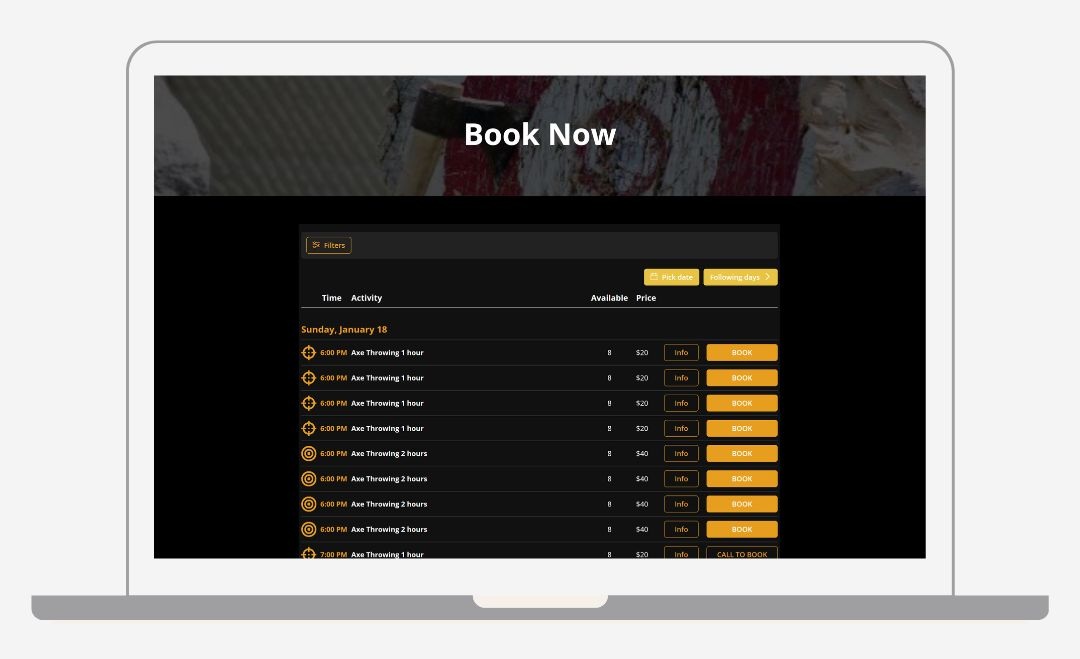
Dynamic pricing adjusts rates based on the day and time booked. The integrated booking cart lets customers reserve multiple experiences at once. Digital waivers collect participant information before arrival and eliminate paperwork.
Conclusion
Axe throwing SEO might seem complex at first, but you can break it down into useful steps that make it manageable. Begin with your Google Business Profile, optimize your website for mobile and speed, then build local citations. Create content that answers real customer questions and earn backlinks through genuine partnerships.
The competitive nature of the industry means local search dominance matters more than national visibility. Own “[your city] axe throwing” searches rather than chasing broad terms.
Combine your SEO efforts with optimized axe throwing booking through Bookeo. Strong search rankings bring visitors to your site, while instant reservation capabilities convert them into paying customers. Execute these strategies, and you’ll see measurable results within months.