
How to Reduce Spa No-Shows with Deposits and Automated Spa Reminders
A spa no-show is quiet. Nobody calls, nobody complains, and the only evidence is a prepared treatment room, a therapist standing by, and an hour of revenue that cannot be sold again once the clock has moved past it. Because the loss is silent, many spa owners underestimate how much it adds up to across a year, and because the cause often looks like simple forgetfulness, many assume there is little they can do about it. Both assumptions are wrong. Spa no-shows respond predictably to two levers that any spa can control: asking for money at the time of booking, and reminding the client before the appointment in a way they will actually see. The stakes are rising as the sector grows. According to Statista, the global market size of the spa industry worldwide was projected to expand from nearly 157 billion U.S. dollars in 2024 to more than 228 billion U.S. dollars by 2029, which means more spas competing for the same clients and less room to absorb empty appointment slots.
This guide explains, in plain terms, how deposits, cancellation policies and automated spa reminders work together to reduce spa no-shows. It is written for spa owners and managers, from a single therapist working alone to a multi-location group, and it assumes no prior knowledge of spa booking software.
Why Spas Get No-Shows, and What Each One Costs
A no-show is a client who books an appointment and does not arrive, without cancelling beforehand. A late cancellation is different: the client does tell the spa they are not coming, but only inside the spa’s cut-off window, which is the period before the appointment (commonly 24 or 48 hours) after which the slot can no longer be resold. Both cost the spa money, but a no-show is worse, because the spa has no warning at all and no chance to fill the gap.
The cost of a spa no-show is higher than the cost of a no-show in most other appointment businesses, and the reason is structural. Spas run on resource allocation rather than simple time-slot reservations: each appointment reserves both a qualified provider and an equipped treatment room, so a hot stone massage, for example, ties up a therapist and a room with a stone warmer at the same time. When the client does not arrive, two resources sit idle instead of one, and the room cannot be released to another therapist because it was never offered to anyone else.

The causes of spa no-shows are also more varied than “they forgot”. Client-side causes include forgetfulness, financial concerns, last-minute emergencies, inconvenient timing, and a cause that is specific to wellness settings: fear or anxiety, because clients can feel vulnerable during treatments. Business-side causes deserve equal attention, and they include unclear or poorly communicated policies, no reminders at all, and a booking process so complicated that clients who need to reschedule simply give up and stay away. This matters for what follows, because deposits address the financial and commitment causes, reminders address forgetfulness, and easy online rescheduling addresses the cases where the client genuinely cannot come and needs a painless way to say so.
Deposits, Full Prepayment and Card on File: Which to Use for Which Treatment
There are three ways to attach money to a spa booking before the client arrives, and the right choice depends on the treatment, the client, and how much friction the spa is willing to introduce at the moment of booking.
- Booking deposit: a partial payment taken when the booking is made, with the balance paid at the visit. A deposit can be a fixed amount (for example a flat sum per booking) or a percentage of the treatment price. It is the most common middle ground for spa booking deposits because the client commits real money without paying everything up front.
- Full prepayment: the client pays the entire treatment price at the time of booking. This suits high-value treatments, packages, first-time clients with no history at the spa, and peak-demand slots where an empty room is especially costly.
- Card on file: the client’s card details are collected at booking, but no money moves until the appointment or until a policy is triggered. This is different from a deposit because nothing is charged up front, which keeps friction low while still giving the spa a way to apply a fee if the client does not arrive.
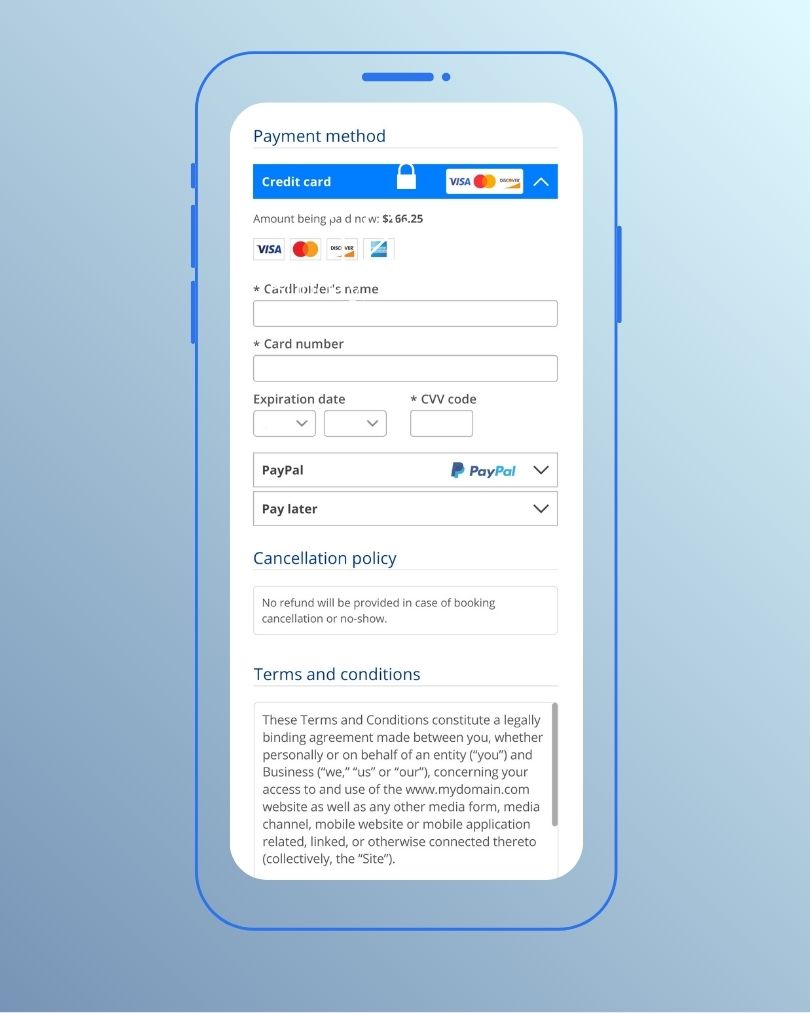
Modern spa booking software handles all three. In Bookeo, for example, a spa can require an online payment or deposit, or choose instead to collect card details to confirm a booking, and it can also let clients decide whether to pay at the time of booking or when they arrive for the appointment. Where a deposit is taken, the balance payment is tracked automatically, so the front desk does not have to reconcile what is still owed. Card details stored to secure a booking can be charged later for add-ons or for a late cancellation, in line with the cancellation policy the spa has set.
How to Set a Deposit Amount (Fixed or Percentage)
A deposit works as a reducer of spa no-shows only if it is large enough that the client would rather attend than forfeit it, yet small enough that it does not stop them booking in the first place.
A percentage deposit in the range of 20 to 50 percent of the treatment price, together with clear refund and cancellation terms, is a sensible starting point for a spa deciding where to begin. A fixed deposit, by contrast, is easier for clients to understand (“a $30 deposit secures your booking”) and is simpler to explain in a reminder message, but it under-protects expensive treatments and over-protects cheap ones unless the spa maintains several fixed tiers.
Whichever model the spa chooses, three further decisions follow. First, decide whether the deposit is deducted from the treatment price at the visit (the normal approach) or treated as a separate booking fee. Second, decide whether the deposit is refundable inside the free cancellation window, which it normally should be, because a refundable deposit is far easier to justify to a client than a non-refundable one. Third, decide what happens to the deposit when the client cancels late or does not show, and write that down in the cancellation policy, which is the subject of the next section. In spa booking software these choices are configured once in the payment settings and then applied automatically to every online booking, so the client sees the deposit requirement before confirming and the spa does not rely on staff remembering to ask.
Writing a Spa Cancellation Policy Clients Actually Read
A spa cancellation policy is the written rule a client accepts at the time of booking. It must state, in plain language, what happens to the deposit at each stage: the free cancellation window, a late cancellation, and a no-show. A policy that is vague about any of those three stages will be argued over at the front desk, and a policy that is never shown to the client will not be enforceable in practice no matter how carefully it was written.
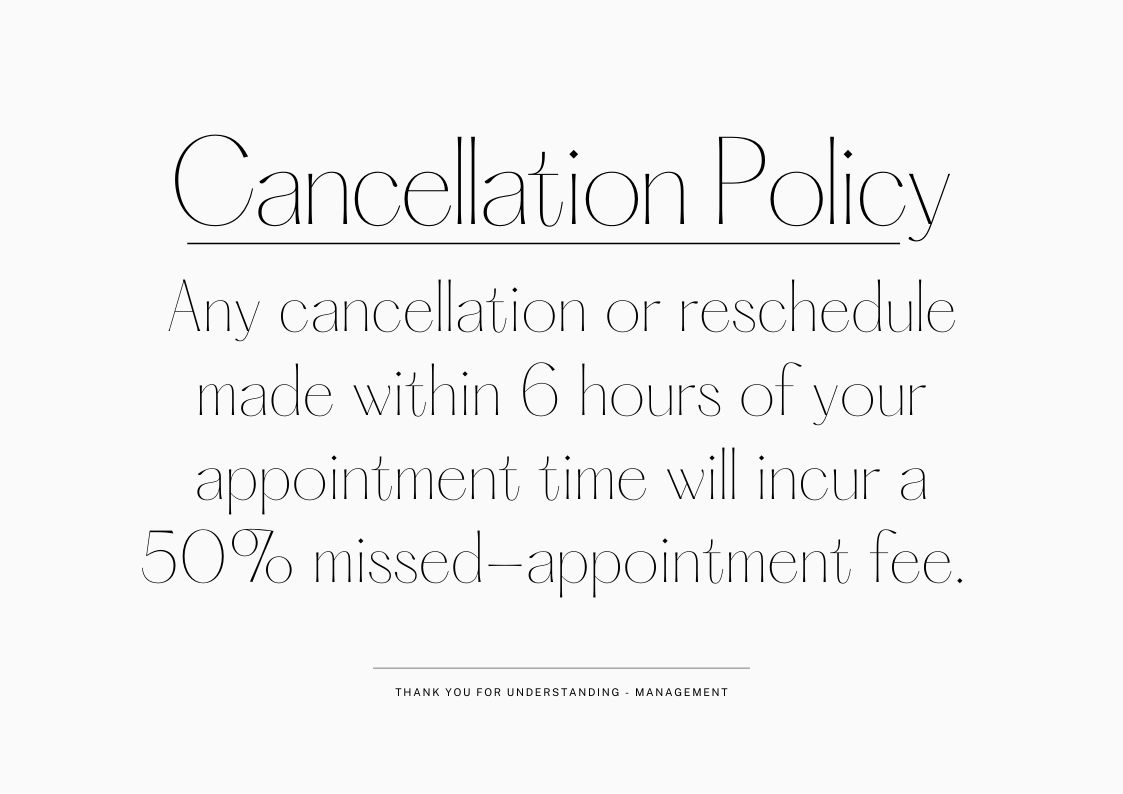
The simplest effective structure is three sentences. A common policy wording follows this structure exactly: cancellations require 48 hours’ notice, less notice incurs a 30 percent fee, and no-shows are charged in full. The value of that wording is that a client can read it in five seconds and knows precisely what is at stake, which is the point at which a spa cancellation policy starts to change behaviour rather than merely describe consequences after the fact.
Beyond the three-stage structure, a few drafting principles make the policy more effective at reducing spa no-shows:
- Match the window to the treatment. A 24-hour window is the usual standard, with a 48-hour window for high-ticket services, and the same logic applies to a spa’s longer or more expensive treatments.
- Allow a first-time grace. Forgiving a first offence protects goodwill while making it clear that the second will be charged.
- Say how the client can cancel. If the policy demands notice, the spa must give the client an easy way to provide it, ideally a link in the confirmation and reminder emails rather than a phone number that is only answered during opening hours.
- Put the policy where the client will see it. Communicate the policy at booking, on the website, in confirmation emails, and in person, because a policy that lives only on a laminated card at reception has not been communicated at all.
What Happens to the Deposit When a Client Cancels, Cancels Late or Does Not Show
Once the policy exists, the spa needs a consistent answer for each of the three outcomes, because inconsistent handling is what turns a reasonable policy into a source of complaints.
- Cancellation inside the free window: the deposit is refunded in full, or, where the client prefers, held as credit against a rebooked appointment. Refund handling is simplest when the refund goes back by the same route the payment came in, so the client sees the money return to the card or payment method they used. Offering the rebook option first is worthwhile because it keeps the client on the calendar rather than sending them away with their money.
- Late cancellation: the policy’s late-cancellation rule applies, which commonly means the deposit is kept in part or in full. Where the client has booked with a card on file rather than a deposit, the late-cancellation fee is charged to that card, and this works the same way for massage and spa bookings alike: the card used to secure the booking is charged later for the late cancellation.
- No-show: the deposit is forfeited, or the no-show fee is charged to the stored card, in whatever proportion the policy sets out. Professional, consistent communication at this stage, with a one-time exception where the circumstances warrant it, is a reminder that the goal is fewer spa no-shows, not maximum fees.
Two operational details reduce friction here. First, every refund or fee should produce a written record the client receives, because disputes almost always begin with “nobody told me”. Second, the spa should track who cancels late and who does not show. Reports on client behaviour that identify skipped time slots and frequent cancellers are what allow the tiered approach described earlier, where only clients with a history are asked for stricter terms.
Setting Up Automated Email and SMS Spa Reminders (Timing That Works)
Automated spa reminders are email and text messages that the booking system sends on a schedule before the appointment, without anyone at the spa having to remember to send them. An SMS reminder is simply a reminder sent as a text message to the client’s mobile phone. Reminders attack the single largest cause of spa no-shows, forgetfulness, and they do so at almost no cost once configured.

The case for text in particular is strong because clients have told researchers they want it. In a 2026 consumer survey of 1,000 U.S. consumers published by a business-texting research provider, 79.6% preferred to get texts about appointment-based services like salons, and nearly three-fourths (74%) check notifications within five minutes of getting a text. A spa appointment reminder sent by text is therefore very likely to be read, and read quickly, which an email reminder cannot promise. The same preference shows up when consumers are asked which texts they value most: in a separate consumer survey of 1,800 U.S. consumers published in 2025, appointment reminders (31%) were ranked as the most valuable type of SMS, ahead of shipping updates and discount offers. Clients do not experience a spa reminder as an intrusion; they experience it as a service.
Timing determines whether the reminder prevents the no-show or merely announces it. The established pattern across wellness, massage and salon businesses is a two-stage one: a first reminder 24 to 48 hours before the appointment and a second on the day itself, typically 2 to 3 hours ahead, with a confirmation at the time of booking as the opening message, timing adjusted to the business, and message overload avoided. The logic behind the two-stage pattern is that the first reminder arrives while the client still has time to cancel inside the free window, so a client who cannot attend can release the slot without penalty and the spa can resell it, while the second reminder on the day catches the client who simply lost track of time.
Customising Spa Reminder Messages and Confirmation Replies
A reminder’s content matters almost as much as its timing, because a reminder that does not help the client act is only half useful. The message should carry the treatment name, the date and time.
That last element is where customised spa appointment reminders earn their place. When each reminder email carries a one-click link to cancel or reschedule, the client who reads the 48-hour reminder and realises they cannot attend is one tap away from releasing the slot. A reminder that forces the client to phone the spa during opening hours is far less likely to produce a cancellation in time, because the client defers the call, forgets, and becomes a no-show.
Beyond the mechanics, a few content choices make spa reminders more effective:
- Repeat the cancellation policy in brief. A single line such as “Free cancellation until 6 pm tomorrow” turns the reminder into a prompt to act now rather than later.
- Mention the deposit. Reminding the client that their deposit is held against the booking reinforces the commitment they made.
- Use the spa’s own voice and brand. Confirmations and reminders should be branded and should read as a message from the spa, not from a faceless system.
- Keep the text short. The SMS reminder should fit in one screen: name and time.
For spas that want a confirmation reply (where the client replies to confirm attendance), the simplest approach is to ask for a confirmation in the first reminder and treat silence as a signal to follow up. The important principle is that every reminder must make it easier for the client to tell the spa the truth about whether they are coming.
Letting Clients Reschedule Online, With a Time Limit
Many spa no-shows are failed cancellations: the client knew they could not come, intended to say so, and never got around to it because saying so required a phone call. The remedy is a self-service rescheduling window, which is the period before the appointment during which the client can move or cancel the booking online without contacting the spa. Giving a client who cannot come an easy exit is one of the most reliable ways to reduce spa no-shows, because it converts a silent no-show into a timely cancellation that frees the slot for resale.
The window needs a limit, and the limit should match the cancellation policy. If free cancellation ends 24 hours before the appointment, self-service rescheduling should end at the same point, so that a client cannot move a booking at the last minute and leave the spa with an unsellable gap. A software cut-off that blocks self-rescheduling inside the window prevents reschedule abuse while leaving the client in control up to that point.
Good spa booking software lets clients reschedule and cancel appointments online without having to call the spa, and the better systems also offer a rescheduling option for cancelled bookings, so that a client whose appointment was cancelled, whether through a staff member’s illness or another unforeseen circumstance, can easily rebook rather than drift away. The spa is notified when an appointment is booked, changed or cancelled, so a released slot is visible to the team immediately and can be offered to another client.
How to Set Up Spa Booking Deposits and Reminders in Bookeo
For spa owners and managers who want to put all of the above into practice in Bookeo, the sequence below follows the order in which a new account is set up, with the deposit and reminder decisions placed where they belong.
- Start a free trial and add the spa’s details. Bookeo offers a 30-day free trial with no credit card required, and the account begins with the spa’s name, address, phone number, and website.

- Add treatments and availability. Set each treatment’s duration and price; you can set different durations and prices per service, combine services into bundles, and set an automatic time gap between slots so the room can reset between clients.
- Add staff and rostering. Assign therapists to the treatments they are qualified to perform and set working hours for each therapist and location.
- Connect a payment gateway. Bookeo integrates with major payment gateways worldwide and does not require the spa to use a proprietary one, so an existing merchant account can usually be kept. Payment processing in Bookeo is PCI-DSS compliant and assessed daily by a third-party PCI-approved vendor, and credit card numbers are never stored on Bookeo’s servers.
- Set the payment terms. Choose, per the tiered approach described earlier, whether a treatment requires full payment, a deposit, or card details only, and whether clients may choose when to pay. Spa booking deposits taken this way are tracked by Bookeo, which records the balance payment automatically.
- Write and attach the cancellation policy. Enter the Terms and Conditions and Cancellation Policy so that clients must accept them to complete an online booking.
- Configure reminder timing. Set the automated spa reminders, by email and text, to the two-stage pattern described earlier, with the first reminder landing before the free cancellation window closes.
- Enable online rescheduling and cancellation. Allow clients to reschedule and cancel online, with the cut-off aligned to the policy.
- Embed the booking page or use the standalone page. The booking widget can be embedded in the spa’s website without pop-ups or overlays, or the spa can use the standalone branded booking page.
- Review the reports after the first month. Use the reporting on client behaviour to identify frequent cancellers and skipped time slots, and tighten the deposit rules only where the data shows a problem.
A No-Show Reduction Checklist for Spas
The following checklist condenses this guide to reducing spa no-shows into a set of decisions a spa can work through in a single sitting.
- Define the three outcomes. Write down what happens to a deposit on a free-window cancellation, a late cancellation, and a no-show.
- Set the deposit model. Choose a percentage or fixed deposit, and decide whether it is refundable inside the free window.
- Draft a three-sentence spa cancellation policy. State the cut-off, the late fee, and the no-show fee.
- Require policy acceptance at booking. Make acceptance part of the online booking flow so that every client has agreed in writing.
- Schedule two reminders. One before the free window closes, one on the day, by email and text.
- Put cancel and reschedule links in every reminder. Make the exit easier than the no-show.
- Align the self-service window with the policy. Block online rescheduling inside the cut-off.
- Add a first-time grace. Forgive one, charge the second.
- Track frequent cancellers. Apply stricter terms only to clients whose history justifies it.
- Review monthly. Compare no-show counts before and after each change rather than guessing.
Frequently Asked Questions
How much deposit should a spa take?
There is no single correct figure, because the right amount depends on the treatment price and how price-sensitive the spa’s clients are. A range of 20 to 50 percent of the treatment price is a common starting point, and a percentage deposit has the advantage of scaling automatically with the treatment. The deposit should be large enough that the client would rather attend than lose it, and the spa should review booking volumes after introducing it to confirm that it has not deterred new clients.
Do deposits reduce spa no-shows?
Yes, because they change the client’s incentive. A client with money at stake has a reason to attend or to cancel in time, whereas a client with nothing at stake bears no cost for simply not arriving. Deposits work best alongside automated spa reminders and easy online cancellation, since the deposit motivates the decision and the reminder and cancellation link make acting on it easy.
Can a spa charge a no-show fee without taking a deposit?
Yes, by collecting card details at booking and stating a no-show fee in the cancellation policy. This is the card-on-file approach: no money moves at booking, but the stored card can be charged if the client does not arrive.
How many reminders should you send before a spa appointment?
The established pattern is a confirmation at the time of booking followed by two reminders: one 24 to 48 hours before the appointment, timed to land before the free cancellation window closes, and one on the day, typically 2 to 3 hours ahead. More than that risks message overload, and fewer leaves the forgetful client without a same-day prompt.
Can clients pay for a spa appointment when they book online?
Yes. Spa booking software lets clients view real-time availability, schedule their own appointments, and make payments anytime on any device, and the spa decides whether a booking requires full payment, a deposit, or card details only. Where the spa prefers, it can also let the client choose whether to pay at booking or at the appointment, with any balance tracked automatically.
Key Takeaways
- Spa no-shows cost more than most no-shows because each appointment ties up both a therapist and an equipped room, so an empty slot idles two resources.
- A spa cancellation policy needs three clear stages: free window, late cancellation, and no-show, each with a stated consequence, accepted by the client at booking.
- Automated spa reminders should arrive twice: once before the free window closes and once on the day, by text as well as email, because clients read texts quickly and rank appointment reminders as the texts they value most.
- Every reminder should contain a one-click cancel or reschedule link, and online rescheduling should close at the same cut-off as the cancellation policy.
- Review the data monthly and tighten terms only for the clients and slots where the reports show a problem.
Conclusion
Reducing spa no-shows is not a matter of chasing clients harder; it is a matter of changing the two things that drive the behaviour. A deposit or stored card gives the client a reason to attend or to cancel in good time, and a well-timed, well-written reminder with a cancel link removes every excuse for staying silent. When those two levers sit inside a clear three-stage cancellation policy that the client accepted at booking, the spa stops arguing about fees and starts filling rooms, and the savings compound with every week of appointments. Spa owners and managers, from single therapists to multi-location spas, who want to put deposits, cancellation policies, and automated spa reminders in place to reduce spa no-shows can set all of it up in Bookeo, the appointment scheduling software built for exactly this purpose, and try it free for 30 days with no credit card required.