Spa Treatment Room and Therapist Scheduling: How Spa Resource Booking Works
A spa appointment requires more than an available time slot. It needs at least two resources to be available simultaneously: a therapist qualified to perform the treatment and a room equipped for it. If either is unavailable, the appointment cannot go ahead, regardless of whether the other is free. This is where a general-purpose calendar falls short, particularly during a busy Saturday. Spa resource booking requires a scheduling system that coordinates therapists, treatment rooms, and availability in a single booking process.
The scale of the problem is easy to underestimate. The International SPA Association, the trade body whose annual study is among the only recurring research efforts devoted solely to the American spa industry, reported in its latest annual industry study that spa visits reached 191 million in 2025 while spa locations grew to just 22,060 and total employment reached 376,900. These figures point to an industry where demand is growing faster than the available rooms and staff, putting increasing pressure on every room-hour and therapist-hour. The booking system plays a crucial role in determining how efficiently that capacity is used. This guide explains how spa booking software helps manage availability, coordinate resources, and make the most of every appointment slot.
What “resource booking” means in a spa
Resource booking is a scheduling method in which a single appointment reserves multiple resources simultaneously. In a spa, these typically include a staff member and a treatment room. The booking system tracks each resource’s availability and only confirms an appointment when all required resources are available for the entire treatment duration. If even one resource is unavailable, the time slot cannot be booked.
This is the single idea that separates spa scheduling software from a general salon or appointment tool. A hairdresser’s appointment is usually complete once a stylist and a time are chosen, because every chair can host every service. A spa cannot make that assumption, because spas run on resource allocation, not only time-slot reservations. A hot stone massage, for example, reserves a therapist plus a room with a stone warmer. Book the therapist without the warmer, or the warmer without the therapist, and the client arrives to a treatment that cannot be delivered.
This is also why generic calendar tools fail: they cannot coordinate provider credentials, room equipment, and variable treatment lengths at the same time. Each of those three is a separate constraint, and a spa booking system has to satisfy all three before it offers a time to a client. The rest of this article walks through each constraint in turn.
Two things every spa appointment reserves: a therapist and a room
A spa scheduling system needs a clear definition of each resource before it can combine them. The definitions below are the ones that matter in practice.
- Therapist (staff) schedule. A therapist’s schedule is their working hours, their breaks, their days off, and the list of services they are qualified to perform. The booking system only offers a time when a qualified therapist and a free room overlap for the full length of the treatment.
- Treatment room. A treatment room is a bookable resource with its own capacity, usually one client at a time, and its own opening hours, which may differ from any one therapist’s hours. A room open from nine to nine can serve a morning therapist and an evening therapist in turn, so the system must track the room separately from either of them. A room can have equipment. Equipment is anything a treatment needs that is not a person or a room: a hydrotherapy tub, a sauna, a laser device, a stone warmer.
Once each resource is defined, a treatment is defined as a recipe: this service needs one therapist from this qualified group, one room from this list, and this piece of equipment, for this many minutes. The booking engine’s job is then to find a time when one of each is free simultaneously. This is what people mean when they say spa booking software “books the room and the therapist together,” and it is what spa management software feature lists are really describing under staff scheduling with qualification matching.
How the booking system decides which times to show a client
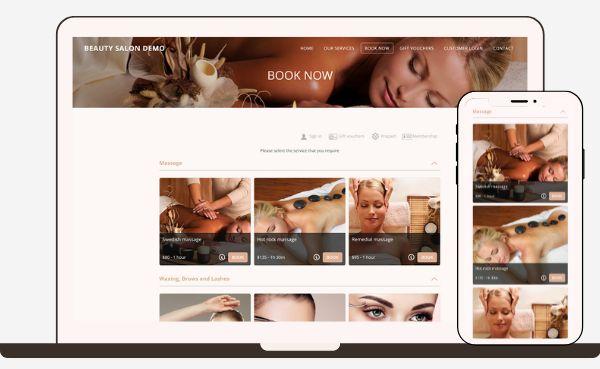
The client-facing side of spa appointment scheduling is the online booking page, sometimes called the client portal. The client sees a list of treatments, then a list of available times, then a form and a confirmation. Behind it, the system runs a set of checks for every time slot in the chosen day.
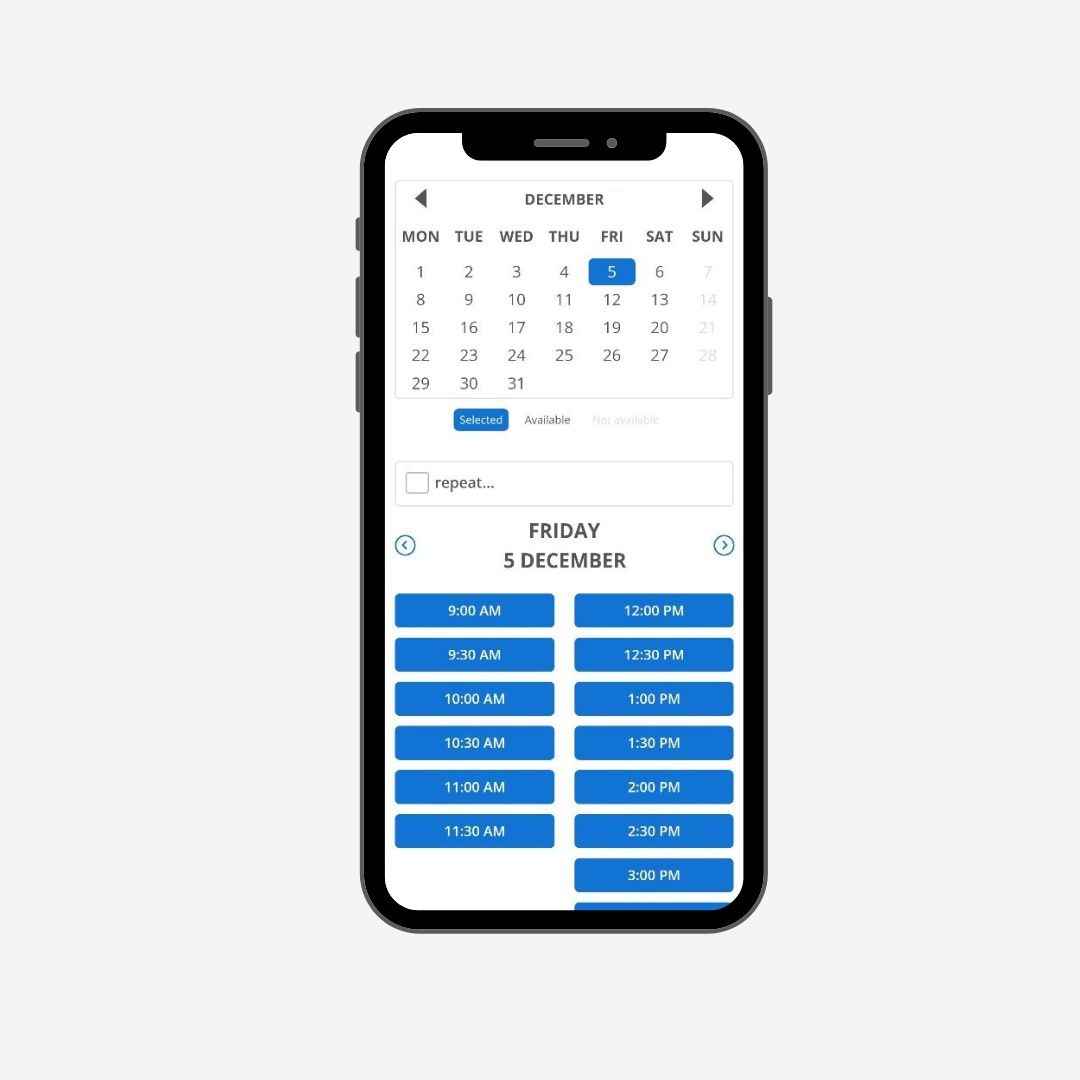
The sequence works as follows. First, the client chooses a treatment, which tells the system which resource recipe to use. Second, the system reads every therapist qualified for that treatment and checks their working hours and existing bookings. Third, it reads every room that treatment can use and checks those rooms’ hours and bookings. Fourth, it looks for time windows long enough to hold the treatment plus any turnaround time (explained in the room section below) where at least one of each resource is free. Only those windows appear to the client as bookable.
This is why a good spa booking system shows clients only available slots rather than the whole schedule. In Bookeo, clients see only the available slots rather than the entire schedule, and they can pick their preferred therapist when the spa allows it. A therapist’s gap is not bookable if every room is full at that hour, so showing the full calendar would mislead the client.
The same engine runs for the front desk. When a receptionist records a walk-in or a phone booking, the system removes that room and therapist from online availability at the same moment. The mechanism is real-time calendar updating: booked slots are removed instantly, and they reopen automatically on cancellation or rescheduling. The front desk and the online booking page are therefore two windows onto one set of resources, which is the only arrangement that prevents a walk-in and an online client from being sold the same room.
Therapist schedules: hours, breaks, and service qualifications
Therapist scheduling is where most of the day-to-day complexity of a spa lives, because people are less predictable than rooms. Workable spa scheduling software needs to hold three kinds of information about each therapist.
- Working hours and absences. Each therapist has their own hours, which may change by day of the week, plus holidays and sick leave. The system must treat these as hard limits, so that a client cannot book a therapist who is not in the building.
- Breaks and preparation time. A therapist cannot run back-to-back treatments without a gap to reset, wash up and greet the next client. The gap belongs to the therapist as well as the room, and the system should block it automatically rather than relying on the receptionist to remember.
- Service qualifications. Not every therapist performs every treatment. A system that lets a client book a prenatal massage with a therapist who is not trained in it has created a cancellation, not a booking. The qualification list is what the booking engine uses to narrow the pool of therapists for each treatment.
Client management is closely tied to the therapist schedule. When a client books, the system attaches the booking to a client record that holds contact details, past appointments, notes, and any intake form the client completed. A therapist can then read the client’s history before the treatment, and a client who always asks for the same therapist can be booked with them through a preferred-staffer option. In spa booking software, the client record and the staff schedule are two sides of the same appointment.
Treatment rooms: capacity, turnaround time, and room-specific services
Treatment room scheduling introduces two concepts that have no equivalent in a general calendar: capacity and turnaround time.
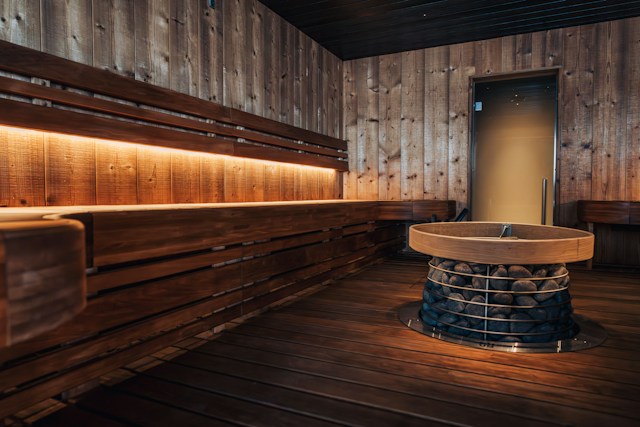
Capacity is the number of clients a room can hold at once. For most treatment rooms it is one, but a relaxation lounge, a sauna or a hydrotherapy area may hold several, and the booking system should let a spa set a different capacity for each. A room with a capacity of one is simply unavailable while it is booked; a room with a capacity of six accepts bookings until six clients overlap, then closes.
Turnaround time, also called buffer time, is the number of minutes added after a treatment for cleaning, re-linening and resetting the room. Its defining property is that it blocks the room without necessarily blocking the therapist, since the therapist may be free to begin a consultation in another room while an attendant resets the first. A system that cannot separate the two will either under-use therapists or over-book rooms.
Room-specific services are the third consideration. Some treatments can only happen in rooms with particular fittings, so the room list for a treatment is often shorter than the full list of rooms. When the spa booking system knows this, it stops offering a mud wrap in a room with no wet area, and it stops the front desk from accidentally promising one.
The same room constraints govern walk-ins. Online booking is the client choosing from the windows the system has calculated; walk-in management is the receptionist placing a client into a window the system shows as open, with the added power to override a rule deliberately when, for example, a room is already clean.
Treatment room scheduling has a commercial dimension as well. Rooms sit idle at predictable times, and spas have begun to use their booking platforms to shift demand into those gaps. A 2026 survey of spa operators published by Spa Business magazine found that 24 per cent of spas now vary treatment prices according to the day or time, and that 18 per cent have introduced automated dynamic pricing through their booking platforms. Neither tactic is possible unless the system already knows, room by room and hour by hour, where the idle capacity is.
Memberships, packages, and gift vouchers tied to the client record
Memberships and packages are prepaid arrangements attached to a client record. A package is a fixed number of treatments bought in advance, with each booking deducting one credit; a membership is a recurring payment that gives the member a set of treatments or discounts each period; a gift voucher is a prepaid balance that the holder can spend on treatments. All three live in the client database rather than in the calendar, and the link between the two is the booking itself: when a package holder books, the system deducts a credit and records it against the appointment.

Can spa software handle memberships and package deals effectively? It can, provided the prepaid item is tied to the client record and the booking engine checks it at the moment of booking.
Running more than one spa location
Multi-location spa booking adds a layer above the resources described so far. Each location has its own rooms, its own equipment, its own therapists and its own opening hours, so the resource recipes have to be location-specific.
In Bookeo, customers choose a branch through a portal, and each branch is a standalone account with its own schedule, staff, customers, vouchers and reports, and data is not shared between branches. The portal manager can access each branch’s back end and pull per-branch portal reports. In practice this means a franchise or a small chain sees one booking front door for clients, and one management view for the owner, while each branch runs its own spa scheduling software setup underneath.
Underneath sits staff and location rostering: hours set for different locations, staff assigned to specific services or locations, and working hours per staffer including holidays and sick leave.
Connecting the schedule to your calendar, payments, and front desk
A spa booking system does not operate alone. Three connections matter most.
- Calendar sync. Owners and therapists live in their own calendars, so the booking system should push appointments into them. In one-way sync, bookings flow from the spa system to the personal calendar only, so the booking system remains the single source of truth. In two-way sync, events created in the personal calendar also block time in the booking system. One-way is safer for a spa, because the room and equipment constraints exist only in the booking system. A well-configured system syncs bookings automatically to the owner’s personal calendar and sends a notification when an appointment is booked, changed or cancelled.
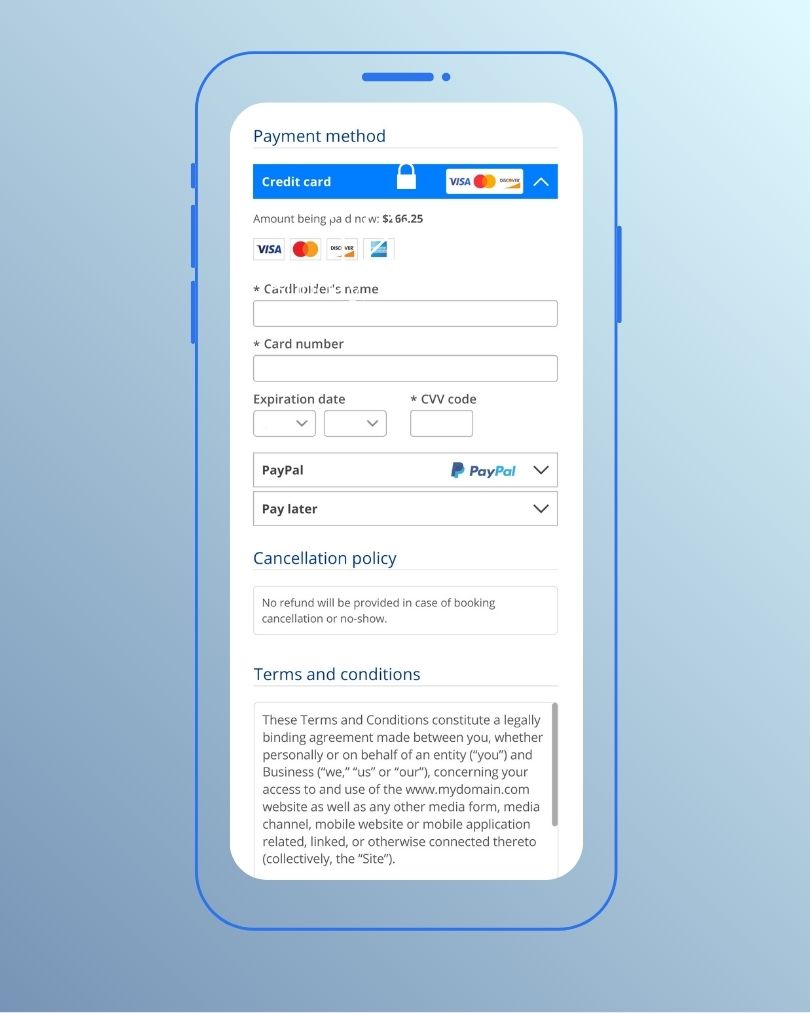
- Payments. A spa should be able to require online payments or deposits to confirm a booking, let clients choose whether to pay at booking or on arrival, and set terms and cancellation policies that clients must accept to complete a reservation. The payment system should also be PCI-DSS compliant, which is the card industry’s security standard for businesses that accept card payments.
- Front desk and reporting. In-store and phone bookings and payments are recorded in the same dashboard as online ones, so the resource picture is complete. Staff and resource utilization tracking is the report a spa manager then uses to see which rooms and therapists are under-used and when.
Taken together, these connections turn spa scheduling software from a diary into the operating record of the spa, and the one place that knows about rooms.
How Bookeo sets up staff, locations, and services for spa scheduling
Bookeo is built around the resource logic described above, so setting it up for a spa follows the same order: services first, then staff and locations, then the rules that connect them. The points below describe how the software works at each of those layers.
- Services with their own durations and prices. Each spa treatment is set up with its own duration and price, and combined services, service bundles and workshops can be scheduled, which is how couples treatments and spa packages are built.
- Staff and location rostering. Staffers are assigned to specific services and locations, and working hours are set for each staffer and each spa, including holidays and sick leave. This is the qualification and hours layer of therapist scheduling.
- Automatic time gap between slots. A gap can be set so there is time to get ready for the next client, which is the turnaround behaviour described in the room section.
- Booking rules and preferred staffer. Spas set their own booking rules, clients see only available slots rather than the whole schedule, and clients can choose their preferred staffer. Spas can also switch off automatic acceptance and review each booking request before accepting it.
- Online rescheduling and cancellation. Clients reschedule and cancel online without calling the spa, and cancelled slots reopen automatically so the room and therapist return to availability.
- Reminders and intake forms. Automatic email and text reminders go out before each appointment, and integrated intake forms collect the client information the therapist needs before the treatment.
- Bookings from Google Search and Google Maps. With the Google Reserve integration, clients make bookings directly on Google and Google Maps without visiting the spa’s website, and those bookings appear automatically on the Bookeo calendar alongside everything else.
For the parts of spa resource booking that involve physical rooms and shared equipment, the same discipline applies: define each treatment’s requirements precisely, keep staff qualifications current, and set turnaround time to the real reset time of each room. The software enforces the rules it is given.
Frequently asked questions
What software do most spas use for appointments?
Most spas use dedicated spa or appointment booking software rather than a general calendar, because a spa appointment has to reserve a qualified therapist and a suitable treatment room at the same time, and often a piece of equipment as well. A general calendar can only reserve a time, so it cannot tell when two appointments in different columns are competing for the same room. The deciding feature is whether the system can model therapists, rooms and equipment as separate, linked resources.
Can spa booking software handle walk-ins as well as online bookings?
Yes. Front-desk staff add walk-ins and phone bookings to the same calendar the online booking page reads, so the room and therapist are blocked for online bookers the moment the walk-in is recorded. The reverse is also true, so there is one set of resources and two ways of booking them.
Should a small spa choose industry-specific software or a generic scheduler?
The deciding factor is the room and equipment requirement. If every treatment can happen in every room with no special equipment, a generic scheduler may be enough. If even one treatment depends on a specific room or a shared piece of equipment, the spa needs a spa booking system that can model that constraint, because a generic scheduler will eventually sell the same room twice.
Is a mobile app or desktop better for spa scheduling?
For a spa, the system should work on both, because the front desk typically uses a desktop or tablet while therapists and owners check the schedule from their phones.
How do you move client data when switching spa software?
Export the client list and future bookings from the old system as a spreadsheet, import them into the new system, and run both systems in parallel for a short overlap so nothing is lost. A typical migration takes roughly three to five days: export on day one, import and configure on days two and three, run in parallel and notify clients on day four, then deactivate the old system once its remaining appointments have passed, going live in a low-volume period.
Key Takeaways
- Resource booking is the defining concept. A spa appointment reserves a therapist, a room and often equipment at the same time; if any one is unavailable, the slot is unavailable.
- The booking engine shows only feasible times. It checks qualified therapists, suitable rooms and required equipment for every slot, and offers the client only the windows where all three overlap.
- Turnaround time blocks the room, not always the therapist. Separating the two is what lets a spa use therapists fully while keeping rooms clean.
- Couples and group bookings are multi-resource recipes. Two therapists plus a double room, booked and released as one appointment.
- Memberships, packages and vouchers live on the client record. The booking deducts credits and carries the payment status into the room.
- Configuration quality decides capacity. The software enforces the rules it is given; precise treatment definitions and current qualifications are what turn capacity into revenue.
Conclusion
Spa resource booking is the discipline of reserving people, rooms and equipment together, and every feature a spa owner is told to look for in spa booking software traces back to that one requirement. Once the therapists, rooms and equipment are defined as resources with their own hours and qualifications, the booking engine can do the work that a general calendar never could: show a client only the times that are genuinely possible, protect the front desk from selling the same room twice, and give the owner a true picture of where capacity is going unused. For spa owners and managers, from a single therapist with one room to a multi-location spa, Bookeo provides appointment scheduling software with staff and location rostering, automatic time gaps between slots, online booking and payments, and a 30-day free trial that requires no credit card.