

SEO for Personal Trainers: Why Your Competitors Are Stealing Your Clients (And How to Stop Them)
SEO for personal trainers matters more than you think. Right now, 46% of all Google searches have local intent. Potential clients are looking for trainers near them. Most personal trainers aren’t optimizing their websites for search engines, which creates a massive chance for you. Over 53% of all website traffic comes from organic search, and people searching for fitness services convert at much higher rates than casual content readers. We cover everything from Google Business Profile optimization to personal trainer SEO strategies that bring in booked sessions, not just traffic.
Why your competitors show up first on Google (and you don’t)
Your competitor down the street isn’t necessarily a better trainer than you. They’ve just figured out how Google’s local search algorithm works. You might have better credentials, more experience, and superior client results. But none of that matters if potential clients never find your website.
The local search reality for personal trainers
Someone searches for fitness services in your area. You’re not competing against every personal trainer globally. You’re competing against the handful of trainers in your geographic region who’ve optimized their online presence. Most personal trainers ignore local SEO entirely and rely on Instagram posts. They hope referrals will sustain their business. This creates a massive gap you can exploit.
Google prioritizes businesses differently depending on where results appear. Your ranking in Google Maps is different from your position in the Local Finder. Both operate separately from organic search results. Each uses distinct algorithms with different weighting for ranking factors. A business might dominate the map pack (those top three local listings) while barely appearing in standard organic results.

Reviews drive local search rankings more than any other factor. Google evaluates review quantity, recency, velocity (how frequently you receive new reviews), and overall ratings when determining your visibility. The diversity of your reviews matters too. Testimonials spread across Google, third-party sites, and your own website carry more weight than reviews concentrated on a single platform. Text-based reviews outperform star ratings alone. Reviews from Google Local Guides or professional reviewers may influence rankings more than those from first-time reviewers.
Physical location creates ranking challenges you can’t always control. Take the case of a trainer operating on the outskirts of town. They’ll struggle to appear for searchers in residential areas near the city center. Businesses located outside Google’s mapped city borders face difficulty ranking for customers physically inside those boundaries.
How search visibility translates to booked sessions
Search rankings directly affect your revenue. Research shows that 76% of people who search for something nearby on their smartphones visit a related business within a day. More telling: 28% of those searches result in a purchase. Someone types “personal trainer near me” or “best personal trainer in [city].” They’re not browsing casually. They’re ready to hire.
First-page placement becomes critical when you think that 70-90% of users click on first-page results. You’re buried on page five. You’re invisible to potential clients actively seeking your services. Ranking in the top three map listings puts your business in front of highly motivated leads and increases clicks, calls, and actual foot traffic.
The intent behind local searches separates them from general fitness content consumption. People searching location-specific queries know what they need and where they want to find it. They’re much closer to making a hiring decision than someone reading a general workout article on social media.
What happens when potential clients can’t find you
Invisibility costs you clients every single day. You’re posting workout videos and hoping someone will notice. Your competitor with an optimized Google Business Profile is filling their schedule with people who found them through search.
Search engines have become the main method for personal trainers to acquire new clients. You don’t appear in search results. Prospects assume you either don’t exist or aren’t established enough to rank. Higher rankings build immediate credibility. Potential clients associate top search positions with expertise and reliability, even if that trainer has less experience than you.
Poor visibility compounds over time. Your competitor collects more reviews, strengthens their online authority, and widens the gap between their visibility and yours. Six months of consistent optimization creates momentum that brings them clients with minimal ongoing effort. You’re still wondering why your phone isn’t ringing.
The fitness industry competition continues to grow. But most personal trainers still haven’t mastered how search engines work. Simple local SEO optimization can leapfrog you over competitors who’ve been in business longer but never learned personal trainer SEO fundamentals.
Google Business Profile: claim your spot on the map
Google Business Profile (formerly Google My Business) operates as a free tool that places your personal training business in Maps and local search results. This matters because people searching “personal trainer near me” see these profiles before they reach organic website listings. The setup takes 10-15 minutes, and verification happens within days.
Setting up your profile the right way
Visit google.com/business and sign in with a Google account you check often. Google sends notifications to this email, so use credentials you won’t lose access to. Click “Manage now” and search for your business name. Claim it if your business already exists in Google’s database. Create a new listing if not.
Your business name appears in every search result, so format it the right way. Use your actual name followed by your service: “Sarah Thompson Personal Training” works. “Mike Davies Fitness Coach” works. “Best Personal Trainer London Fitness Expert Weight Loss” violates Google’s guidelines and triggers penalties. Keep it straightforward and honest.
Choose “Personal Trainer” as your primary category. This single selection determines which searches display your profile, so it carries weight for personal trainer SEO. Add secondary categories like “Fitness Center,” “Weight Loss Service,” or “Sports Nutrition” only if they describe services you provide. Each category increases visibility for specific searches, but irrelevant categories confuse potential clients.
Service area businesses operate differently from fixed locations. Select “I deliver goods and services to my customers” during setup if you train clients at their homes, in parks, or at multiple gyms. Define the cities and neighborhoods you serve. Google displays your profile to searchers in those areas even without a physical storefront address. Trainers with fixed studios enter their exact street address instead.
Provide a phone number you answer, or that connects to a professional voicemail. Include your website URL if you have one. Verified businesses appear 2.7 times more reputable to customers and receive 42% more direction requests. Verification happens via a postcard sent to your address, though phone and email verification options sometimes appear.
Complete every field Google offers. Profiles with detailed information rank higher because Google prefers detailed business data. Add your hours, description, founding date, and attributes. The business description gives you 750 characters to explain who you serve, your specialties, and your qualifications. Write in a natural way and incorporate location keywords without stuffing.
Adding photos and services that convert
Visual content separates strong profiles from weak ones. Businesses with photos receive 42% more requests for directions and 35% more website clicks compared to businesses without images. Upload a minimum of 10-20 high-quality photos showing your training style, equipment, and workspace.
Start with a professional profile photo of yourself in training gear. This image appears next to your business name in search results. Add a cover photo showcasing your best training space or a dynamic action shot. These create first impressions before potential clients read anything about your services.

Action photos of training sessions demonstrate your coaching approach, but get client permission first. Photos with people in them generate 42% more direction requests than equipment-only shots. Include images of your facility exterior if you have a fixed location, interior shots showing your equipment, and before-and-after transformations where appropriate and within professional scope.
Update photos monthly with fresh content. Regular photo additions signal to Google that your business stays active and relevant. Drip-feed new images rather than uploading everything at once.
List each service you offer in the services section. Include descriptions and pricing when possible. Services appear in search results separately and expand your visibility across different searches. This section often gets overlooked, but it functions as an SEO optimization for personal trainer profiles.
Getting more reviews than your competition
Reviews function as the single biggest ranking factor in local search. Google evaluates quantity, recency, velocity (how fast you accumulate new reviews), and overall ratings. Businesses with ratings above 4 stars get many more clicks than competitors with lower scores. Note that 97% of customers read local reviews before making decisions.
Build a systematic approach rather than hoping clients leave feedback. Ask when clients feel happiest: after achieving a personal record, hitting a weight loss milestone, or completing their first month. Send them a direct link to your review page instead of making them search for your profile. Simplify the process.
61% of mobile searches result in phone calls, and reviews influence whether that call happens. Create a simple request message: “Hey [Name], congrats on hitting your [milestone]! If you’re happy with your training, would you mind sharing a quick review? Here’s the link: [direct review link]. Takes two minutes and helps me reach more people who need support, as you’ve gotten.”

Respond to every review. Thank positive reviewers by name and mention specific achievements you’ve worked on together. Address negative reviews in a professional manner without defensiveness. Offer to discuss concerns through email or phone. These responses show potential clients you value feedback and handle problems well.
Review velocity matters more than total review count in some cases. Three reviews this month signal more activity than 50 reviews from three years ago. Maintain a consistent review flow rather than collecting them all at once and going silent.
SEO optimization for personal trainers: making your website visible
Your website reinforces what your Google Business Profile initiates. Clients who find you on Maps often click through to your site before booking. What they see there determines whether they schedule a consultation or move to the next trainer. Personal trainer SEO extends beyond profile optimization into how search engines read and rank your actual website pages.
Using location keywords naturally on your site
Location-based keywords help Google connect your business with geographic searches. Someone typing “personal trainer in Portland” expects results from Portland trainers, not generic fitness content. Your website needs clear location signals throughout its pages so Google understands where you operate and who you serve.
Start with your homepage. Your title tag should include your city or neighborhood (60 characters maximum). Format it as: “Personal Trainer in [City] | [Your Name] Fitness.” The meta description (160 characters maximum) should mention your location again. Write: “Get fit with [City]’s top-rated personal trainer. Customized programs, proven results, flexible scheduling.”
Your homepage H1 header carries the most weight for rankings. Use “Personal Training in [City Name/Neighborhood]” as your main header. Mention your location naturally throughout homepage copy without keyword stuffing. Write something like: “I’m a certified personal trainer serving [neighborhood] and surrounding [city] areas. My [location] studio offers personalized training programs designed for busy professionals”.

Spread location keywords across multiple pages. Your about page should reference your local roots and community involvement. Service pages benefit from specific keywords like “HIIT classes in [city]” or “strength training for beginners in [city]”. Each page targets one long-tail keyword: homepage gets “personal trainer [location],” about page gets “fitness coaching in [location],” and so on.
Include your primary keyword once in your page title, meta title, meta description, first paragraph, and last paragraph. This strategic placement signals relevance without triggering spam filters. Secondary keywords fill out the rest of your content naturally.
Creating separate pages for each service area
Service area pages expand your visibility across multiple locations without requiring physical storefronts in each city. If you train clients in Brooklyn, Manhattan, and Queens, create separate landing pages for each borough. Format URLs as: yoursite.com/personal-trainer-manhattan, yoursite.com/personal-trainer-brooklyn.
Each service area page needs original content addressing that specific location. Duplicate pages with only the city name swapped trigger Google penalties. Write at least 300-500 words covering:
- Opening paragraph introducing your services in that specific area
- 2-3 paragraphs on local specialties or community involvement
- Testimonials from clients in that location
- Embedded Google Map showing the service area
- Contact form with clear call-to-action
Reference local landmarks and neighborhood names to prove you know the area. A Brooklyn page might mention Prospect Park training sessions or working with clients near the Brooklyn Bridge. Location-specific details build trust and improve rankings.
Why NAP consistency matters everywhere online
NAP stands for Name, Address, and Phone number. These three elements must appear the same way on every online platform where your business exists. Even small variations confuse search engines and damage your local search visibility.
Google uses directories and listings to measure prominence, a key factor in local algorithm rankings. When search engines encounter inconsistent NAP information, they may interpret listings as separate businesses and dilute your visibility. 73% of users lose trust in a brand if business listings contain inaccurate data.
Maintain the same NAP formatting on your website, Google Business Profile, social media profiles, email signatures, and business directories. Choose one format and stick with it. If you write “123 Main Street, Suite 100” on your website, use that exact format everywhere. Don’t switch between “St.” and “Street” or “#100” and “Suite 100”.
Accuracy matters more than perfect consistency. Google understands that “St” and “Street” reference the same thing, but your information must be correct. 52% of people leave negative reviews after finding false or incorrect online information. Wrong phone numbers or outdated addresses cost you clients and reputation.
Check your NAP on your website header, footer, contact page, Google Business Profile, Facebook, Instagram, LinkedIn, and major directories like Yelp. Audit these listings quarterly to catch any platforms that changed your information without permission.
Content that ranks and converts clients
Content creation answers two critical needs for personal trainer SEO: it attracts search engine attention and converts visitors into paying clients. Blogging increases your likelihood of appearing in organic searches by 4x. Companies with content marketing strategies use blogging 48% of the time, and 56% of those report it works. Search engines reward websites that publish helpful, relevant information regularly.
Writing blog posts with local angles
Local content separates you from generic fitness advice that floods the internet. Blog posts that target geographic searches bring qualified traffic and demonstrate local expertise. Someone who searches “outdoor workout spots in Brooklyn” wants specific Brooklyn locations, not general fitness tips that apply anywhere.
Structure local posts around recognizable landmarks and community events. Write neighborhood workout guides like “Best Outdoor Training Spots in [Neighborhood]” or “[City] Hiking Trails for Fitness Training”. Seasonal content works well too: “Staying Fit During [City] Winters” addresses climate-specific challenges your local clients face.

Cover local events that line up with fitness. Tips for your city’s marathon runners or preparation guides for local 5K races attract people who have committed to fitness goals. Community involvement posts about partnering with local charities for fitness fundraisers build authority while creating shareable content.
Each local post needs your city or neighborhood name in the title, location references in the first paragraph, and links back to your location pages. This optimization signals relevance to search engines and readers.
Client results within your scope
Success stories drive SEO performance and conversions, but personal trainers must stay within professional boundaries. You can’t diagnose conditions, prescribe treatments, or make medical recommendations. Stick to what you influenced: training consistency, strength improvements, and confidence building.
Focus transformation stories on the client’s starting point and goals, your training approach, specific strength or performance improvements, and how their relationship with exercise changed. Get client permission before you publish anything.
Avoid mentioning medical improvements, health claims, or anything that suggests you treated or cured medical conditions. A story about a client who “improved their squat from 95 to 185 pounds in six months” stays within your scope. Claims about lowering their blood pressure cross professional boundaries.
Exercise demonstrations that search engines love
Video content has become the number one driver of new customers, according to marketers. Videos on social media generate 1,200% more shares than text and image posts combined. 60% of millennials prefer watching videos over reading newsletters to learn about companies.
Exercise demonstrations showcase expertise that competitors can’t replicate. Proper form demos for compound movements, exercise modifications for different fitness levels, and common form mistakes and corrections all perform well.
This content targets keywords like “[exercise name] form,” “how to do [exercise],” or “[muscle group] exercises at home”. Videos keep visitors on your site longer, which signals value to Google.
Questions your clients ask
Educational content within your scope builds authority. You can teach exercise science, movement principles, and fitness concepts that line up with your qualifications. The difference between strength and endurance training, how to progress exercises safely, and understanding simple movement patterns all fit within professional boundaries.
Create posts that address common client questions like “What should I look for in a personal trainer?” or “How much does personal training cost in [your city]?”. These informational searches bring people early in their decision process.
The first organic result on Google receives 10x more clicks than other results. Quality content relevant to search intent, well-researched, and helpful gets prioritized. Blog SEO ranks as the third most popular strategy for website traffic after social media and email marketing.
Building authority beyond your website
Off-site signals carry substantial weight for personal trainer SEO. You create validation signals that Google uses to measure your expertise and local authority when you build credibility beyond your own website.
Getting listed in certification directories
Most certification bodies provide directory listings that trainers ignore. These directories function as SEO goldmines because they already rank well for fitness-related searches. These directories can appear in top results when someone searches “certified personal trainer near me” or “[specialty] trainer [your city]”.
Claim your profile on ACE, NASM, ISSA, or whichever organization certified you. Complete every field that these platforms offer. Add your specialties, services, location details, and professional photo. Link back to your website. These high-authority platforms pass credibility signals to search engines when they display your information.
Psychology of Eating specialists, personal chef certifications, and specialty fitness credentials also maintain directories. Claim every listing available if you hold multiple certifications. Each profile creates another touchpoint where potential clients find you and where Google verifies your expertise.
Partnering with local businesses and media
Mutually beneficial alliances introduce you to established customer bases while building local SEO authority. You can team up with sports apparel stores, health food markets, or wellness centers and allow cross-promotion that amplifies brand awareness. You position yourself as an expert in specific fields when you connect with yoga studios, physical therapists, or corporate wellness programs.
Local news websites and community publications carry strong local SEO authority. They send powerful signals to Google about your local relevance when they mention your name and link to your website. Offer to speak at community health events, partner with healthcare providers, or participate in charity fitness events. You can provide expert commentary for local health stories and often get backlinks from news sites.
TV appearances deliver strong returns. You can earn a permanent link from their website when you spend five minutes on a local news segment. Make certain your website gets mentioned during any broadcast appearance. Local NBC and ABC affiliate stations link to featured experts.
Earning backlinks from fitness publications
Fitness industry publications seek expert content from qualified trainers. You build authority, drive traffic, and create valuable backlinks when you contribute to these outlets. Guest articles for fitness blogs, expert quotes for health publications, and interviews about your specialties all generate links pointing to your site.

Target local newspapers’ health sections, community fitness blogs, corporate wellness newsletters, and specialty publications for your niche, like women’s health or senior fitness. Pitch stories that line up with current trends or seasonal themes to increase acceptance rates.
Technical fixes that improve your rankings
Technical performance determines whether visitors who find you through search stay on your website. 52% of internet searches happen on mobile phones, and 60% of local searches occur on mobile devices. Your site’s mobile failure makes you invisible to most searchers looking for personal trainers.
Making your site mobile-friendly
Personal trainer SEO now requires mobile optimization. Google uses mobile-first indexing and prioritizes mobile versions when making ranking decisions. Your site must adapt to all screen sizes through responsive design.
Smaller screens need streamlined navigation. Restricted screen space means mobile menus should limit themselves to five items maximum. Primary navigation should feature popular pages. Buttons need a minimum tap area of 45px square so thumbs can hit them. Small, fiddly buttons frustrate users and increase bounce rates.
Load times kill conversions. Your site should load in under three seconds. Longer loading pages trigger immediate abandonment. Keep the total site size under 1MB, so it loads on WiFi and cellular connections. This may require mobile-specific versions with fewer images than desktop layouts.
Click-to-call functionality matters. Make phone numbers tappable so mobile users can call with one tap. Display your location and contact information above the fold so visitors don’t scroll searching for simple details.
Speeding up image-heavy pages
Training photos showcase your expertise, but slow sites when unoptimized. Compress images without quality loss. Files should range from 70-500 KB. WebP format provides 26% smaller files than PNG and 25-34% smaller than JPEG while maintaining quality.
Resize images to the actual display dimensions before uploading. A 1266-pixel wide image can reduce filesize by 89% compared to full-resolution versions. Enable lazy loading so images below the fold load only when users scroll to them.
Setting up schema markup for local businesses
LocalBusiness schema helps search engines understand your business details and makes you eligible for rich results. Required properties include your business name, physical address, and aggregate rating. Recommended additions cover geographic coordinates, opening hours, price range, phone number, and URL.
Google’s Structured Data Markup Helper generates code you paste into your homepage header. Test implementation with Schema Markup Validator to confirm zero errors.
Tracking what’s working (and what’s not)
Without measurement, your SEO optimization for personal trainer efforts remain guesswork. You need data showing which strategies bring clients and which waste time.
Monitor your local search rankings
Google Search Console provides free visibility into searches, bringing you traffic. Filter by location to see local performance. Track impressions versus clicks for location-specific queries. Manual searches give you another layer of insight. Search your target keywords in incognito mode and note your position against competitors. Do this regularly.
Track these phrases: “personal trainer [city],” “personal trainer near me,” “[specialty] trainer [city],” and “[neighborhood] personal training”. Your Google Business Profile dashboard shows profile views and search queries triggering your listing. It also shows actions like calls or direction requests.
Use Google Analytics to measure traffic
Google Analytics reveals organic search traffic trends and which pages attract the most local visitors. You can see geographic visitor locations. Behavior patterns show how long visitors stay. They also reveal which content keeps them engaged.

Set up conversion tracking to measure consultation requests
Goals transform vanity metrics into revenue indicators. Set up tracking to measure contact form submissions and phone calls. These conversions measure how well you turn visitors into leads.
Trends matter more than single months. Look for consistent improvement over 3-6 month periods.
Converting search traffic into booked training sessions
Traffic means nothing if visitors leave without booking. Your search visibility brings prospects to your website, but friction in the booking process sends them to competitors who make scheduling easier.
Streamlining your booking process with online scheduling
Clear calls-to-action on every page prompt visitors to take the next step. Buttons should say “Book a free discovery call” or “Schedule your consultation today” instead of vague phrases like “Submit” or “Learn More”. Too many steps kill conversions. Long intake forms overwhelm potential clients. Keep the first contact simple and get just enough information to start the conversation.
Why Bookeo makes it easy for leads to become clients
Bookeo’s fitness scheduling software lets clients view live availability and complete bookings 24/7 from any device. The booking process happens in just a few steps: clients see your schedule, select their preferred time, and pay online through integrated gateways like Stripe, Square, or PayPal. All payment activity is combined into a single dashboard. You can require full prepayment, collect partial deposits, or allow pay-later options.
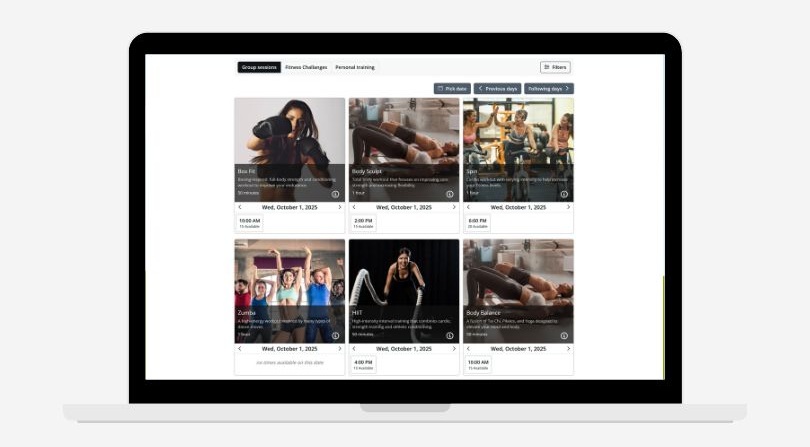
Automated follow-ups that keep prospects connected
Automated email sequences keep you connected with leads who aren’t ready to commit right away. Research shows 80% of sales require five or more follow-up touchpoints. Bookeo’s personal training scheduling software sends automated confirmation messages after booking and reminders before scheduled sessions. This reduces no-shows and keeps your calendar accurate.
Conclusion
Search visibility separates booked trainers from those struggling to fill their schedules. Your competitors aren’t necessarily better trainers. They’ve just figured out how local SEO works. Implementing these strategies takes time and consistent effort, but the payoff compounds over months.
Start with your Google Business Profile today. Optimize your website with location keywords. Create content that answers real-life client questions. Track your progress monthly rather than obsessing over daily fluctuations.
Prospects who find you through search and book easily through Bookeo’s class scheduling system will help you spend less time chasing leads and more time training clients. That’s the difference between hoping for referrals and building a predictable client acquisition system.